

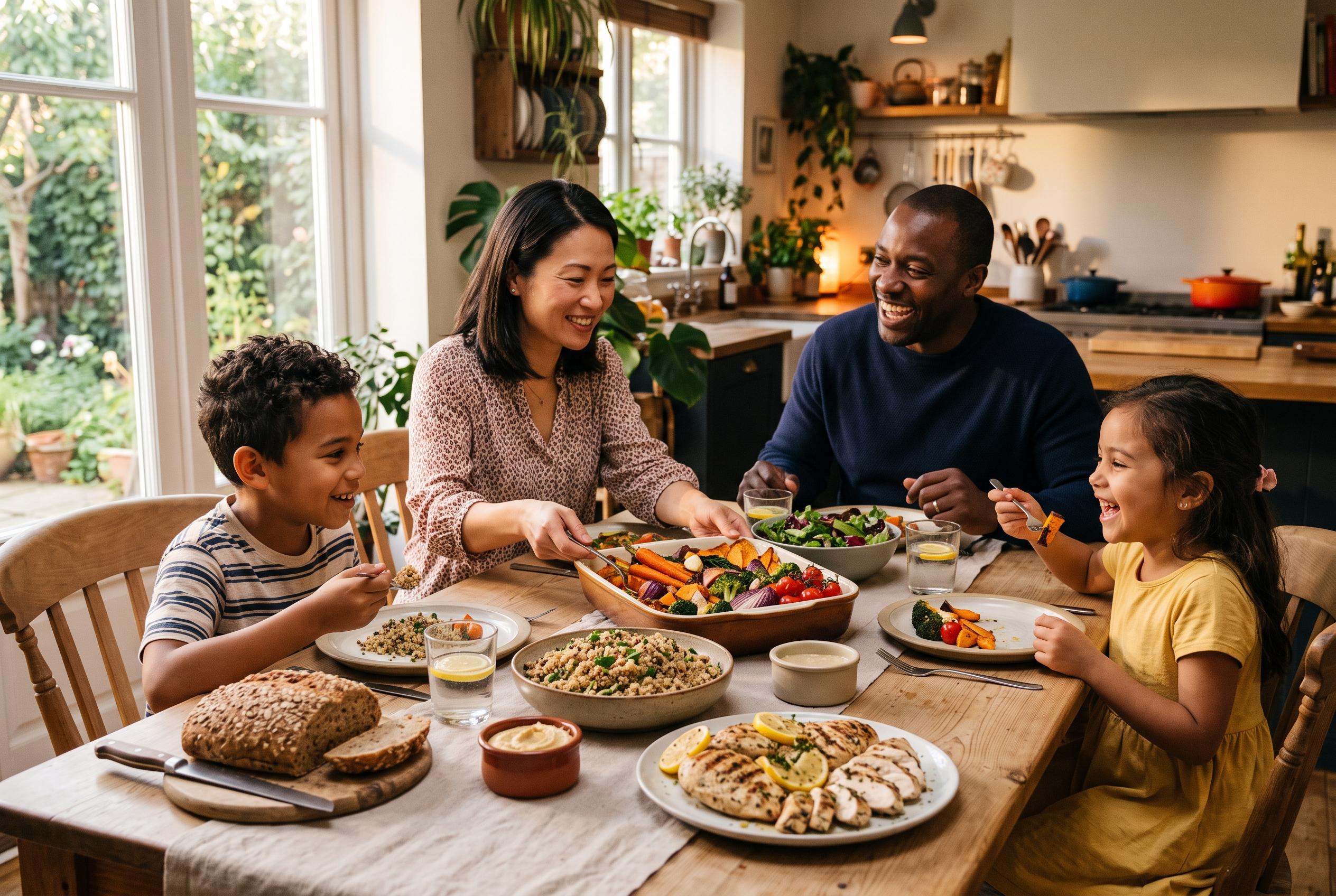

A practical approach to nutritious family dinners emphasizes simplicity, familiar ingredients, and time-efficient methods to suit busy lifestyles while maintaining a balanced, heart-healthy diet.
Healthy family dinners do not need to be elaborate to be worthwhile. The most workable approach is usually the simplest: build meals around a balanced plate, keep a short list of repeatable recipes, and rely on methods that save time, such as sheet-pan, one-pot and slow-cooker cooking. The American Heart Association’s guidance and its balanced-plate materials both point in the same direction: half the plate should be fruit and vegetables, with the rest split between lean protein and whole grains.
That framework matters because family dinners have to work in the real world, not in an ideal one. Busy parents need meals that are quick enough for weeknights, flexible enough for mixed tastes and affordable enough to repeat. The Heart Association’s kitchen-prep advice highlights pantry and freezer staples such as beans, whole grains, lean proteins and frozen fruit and vegetables, all of which make it easier to put together a nourishing meal without an extra supermarket trip. Mayo Clinic’s heart-healthy menus make a similar case for practical, lower-salt, lower-fat cooking built around familiar ingredients.
For families short on time, the best dinners are usually the ones with the least decision-making. A sheet-pan meal, a simple stir-fry, a frittata or a taco-style bowl can all be assembled quickly and adapted to whatever is already in the fridge. Keeping a stocked base of eggs, beans, whole grains, frozen vegetables and a few dependable proteins means dinner can be improvised without becoming unhealthy or expensive. That is also why a rotating list of about 15 to 20 family favourites is more useful than trying to invent something new every evening.
Budget-friendly cooking tends to rely on the same ingredients. Beans, lentils, eggs, canned fish and frozen vegetables stretch further than many fresh convenience foods, while still offering protein, fibre and useful nutrients. The Heart Association’s healthy-eating guidance and meal-prep materials both encourage exactly this kind of pantry-led approach, and Mayo Clinic’s sample menus likewise favour straightforward combinations of vegetables, grains and lean protein rather than heavily processed meals.
For children and picky eaters, the aim is not disguise but repetition. Serving one familiar food alongside a new one, keeping portions small and involving children in preparation can make meals feel less threatening. Over time, that approach is more realistic than making separate dinners or turning the table into a battleground. The same principle works for everyone else at the table: keep the meal structured, keep the flavours simple and allow people to eat the parts they like while gradually broadening what the family accepts.
In practice, the most sustainable family dinner plan is also the least dramatic. Think grilled fish with vegetables and grains, bean-based chillies, chicken with roasted vegetables, pasta with added vegetables and a modest amount of cheese, or a build-your-own taco night with sensible toppings. Those meals fit the heart-healthy pattern, can be scaled for different family sizes and leave room for leftovers, which is often where the real weeknight saving lies.
Disclaimer: This content is for informational purposes only and is not intended to be a substitute for professional medical judgment, advice, diagnosis, or treatment.



