

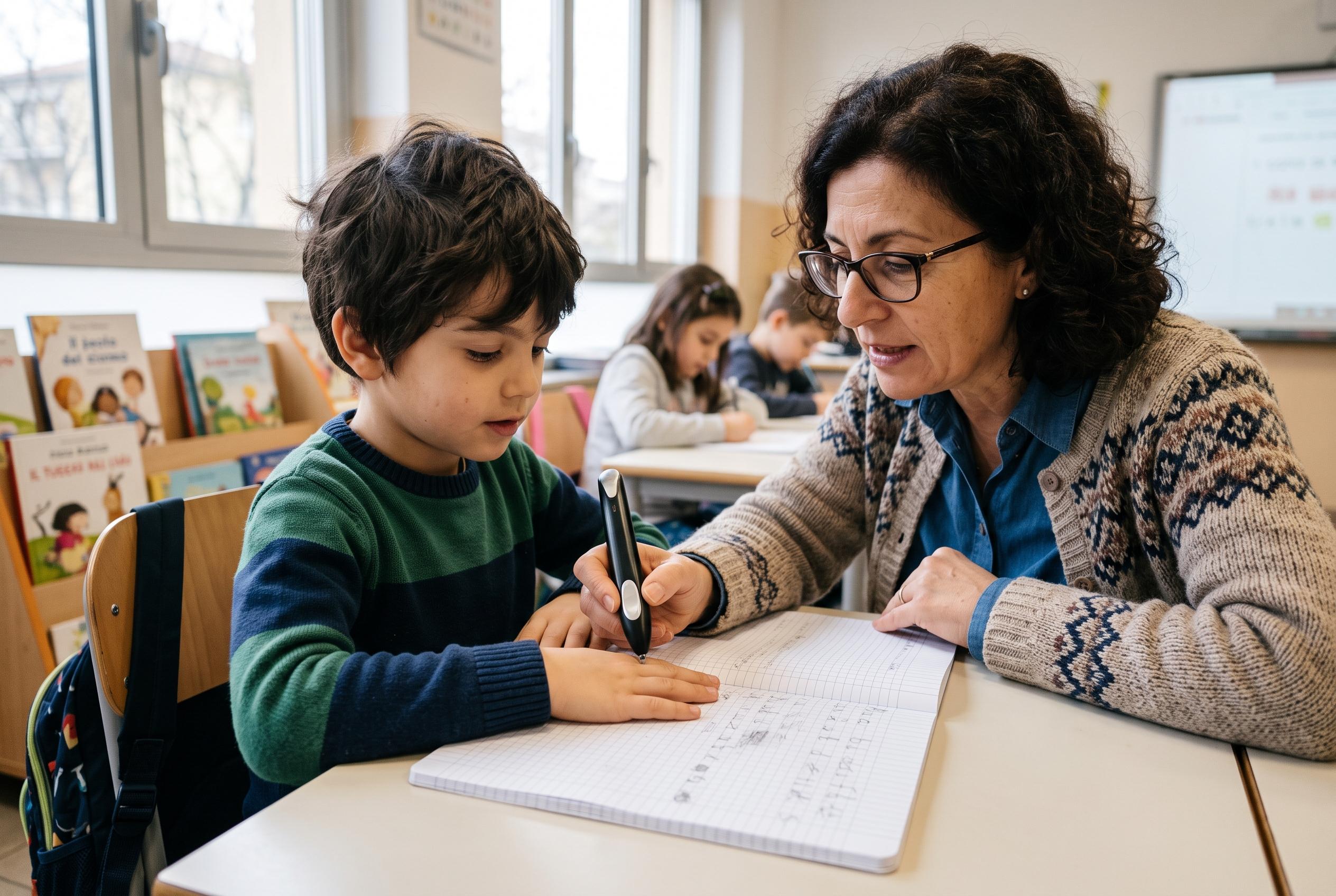

A new sensorised pen developed by researchers in Milan and Varese enables schools to identify handwriting problems such as dysgraphia more promptly, using detailed data and artificial intelligence to support early intervention.
A sensorised pen developed by researchers in Milan and Varese could help schools spot handwriting problems earlier, after a study of more than 700 children found it could track the fine motor patterns linked to writing ability. The work, published in PLOS Digital Health, tested the THInkPen while pupils completed standard writing tasks used in Italy to assess dysgraphia and dysorthography, conditions that affect handwriting and spelling.
Unlike tablet-based tools, the pen lets children write on paper in the usual way while recording detailed information about pressure, movement fluency, pen angle and signal frequency. The researchers said those measurements lined up closely with clinical scores, followed the expected progression from one school year to the next, and allowed artificial intelligence models to distinguish children with writing difficulties from their peers. Explainable AI tools also helped identify which features were behind weaker performance, a step the team says could support more targeted intervention.
The study was led by Politecnico di Milano with the University of Insubria as part of the PRIN project e-School 2.0. Simona Ferrante, who coordinated the Politecnico research team, said analysing the writing process as well as the finished page could help schools identify problems sooner and route children to care more efficiently. Cristiano Termine of the University of Insubria said that mattered because child and adolescent neuropsychiatry services are under growing pressure, and not every classroom difficulty requires specialist assessment.
According to the researchers, the THInkPen was originally developed for screening neurodegenerative disease before being adapted for neurodevelopmental assessment. They say the aim is not to replace clinical testing, but to give teachers and clinicians a more precise, low-friction way to tell when a child may need further help.
Disclaimer: This content is for informational purposes only and is not intended to be a substitute for professional medical judgment, advice, diagnosis, or treatment.



