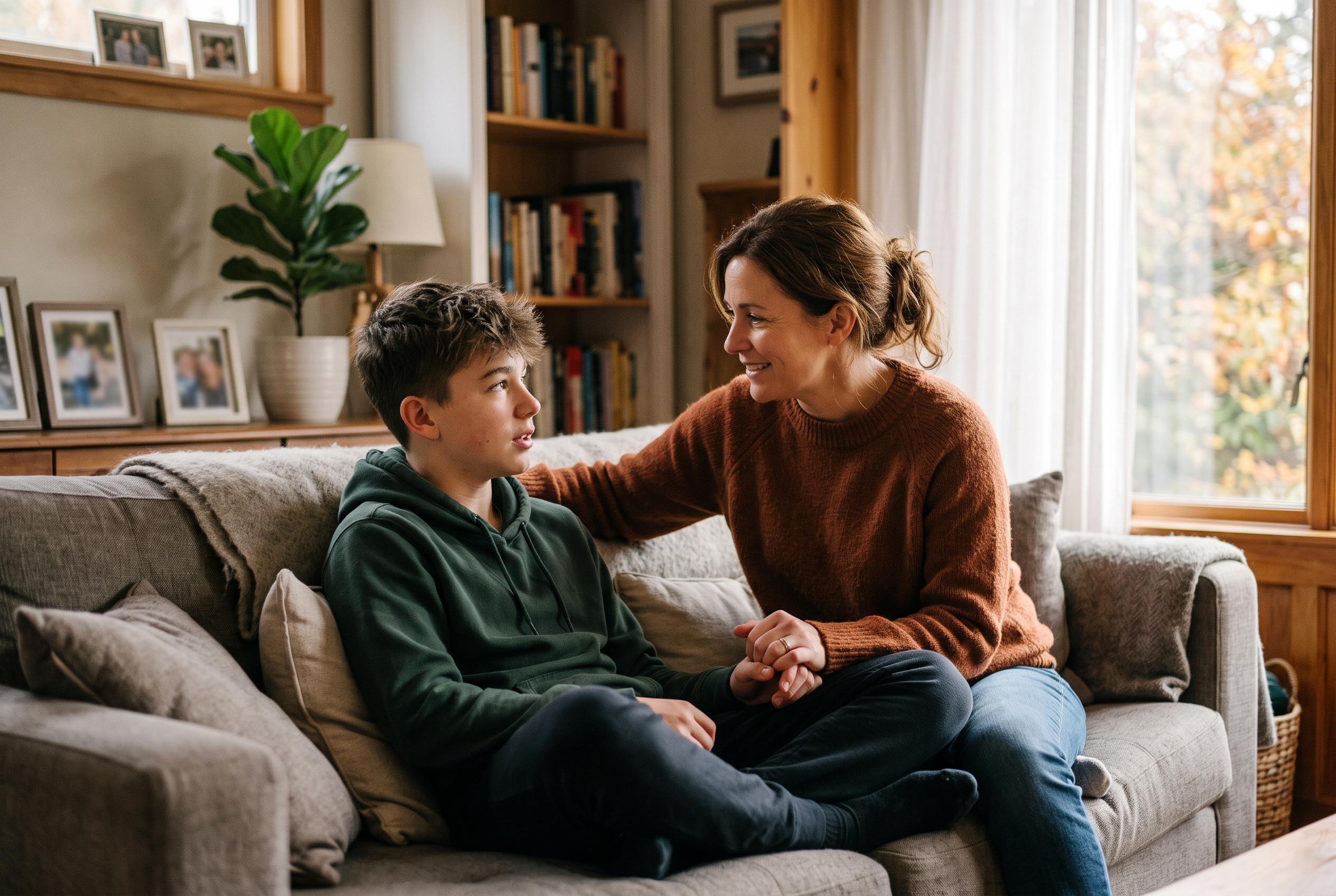

A recent study by Leiden University reveals that how parents respond to their teenagers’ distress can significantly impact their risk of depression, emphasising the importance of warmth and understanding in family dynamics.
Wilma Wentholt says she has long been drawn to children, but her work has taken her into one of adolescence’s hardest subjects: depression. In research completed at Leiden University, the Dutch scholar looked not just at what teenagers said about their parents, but at how parents and children actually behaved when they were put together in a lab setting. Her conclusion was stark: the way parents respond at home can help shape whether a young person sinks further into depression or is better able to cope.
Wentholt’s study focused on families with children aged 12 to 18 who had been diagnosed with depression, alongside a comparison group of families with children who had no psychiatric diagnosis. The teenagers and their parents were asked to discuss conflict, plan a pleasant outing and talk through something upsetting outside the home, while cameras recorded the exchanges. According to Wentholt, the point was to move beyond perception and capture live interaction, rather than relying only on questionnaires about how parenting felt from the child’s point of view.
Her findings cut against some earlier literature. The parents of depressed teenagers did not, on observation, behave very differently from the parents of children in the control group. But the depressed teenagers experienced their parents as less supportive and more critical, and they reacted badly when the adults became controlling. That fits with wider research. A meta-analysis published in Springer found that both positive and negative parenting behaviours can influence depression in children and adolescents, while studies in the Journal of Research on Adolescence and in PubMed-linked research have linked parental autonomy support with lower depression and psychological control with higher depressive symptoms.
Wentholt also challenged the idea that depressed young people simply see the world through a darker lens. Drawing on the broader literature, she said their judgements about parents were often more realistic than those of teenagers without depression, who tended to view parents more favourably. Her interpretation was that healthy family security may help explain that difference: in a stable household, children may be inclined to give parents the benefit of the doubt. Other recent research, including a qualitative study on beliefs about adolescent depression, suggests parents and teenagers often disagree about what is driving the illness, which can make communication and treatment harder.
The practical lesson, according to Wentholt, is that warmth and curiosity matter. Parents should try to understand how a child experiences distress, set boundaries clearly and model the behaviour they want to see, rather than demanding change from the side-lines. That advice echoes other studies showing that parental worry and low confidence can undermine effective parenting, particularly when a teenager is already struggling. Wentholt is now studying how parents themselves cope when a child has depression, a phase she says can leave families feeling trapped in constant contact, guilt and uncertainty.
Disclaimer: This content is for informational purposes only and is not intended to be a substitute for professional medical judgment, advice, diagnosis, or treatment.