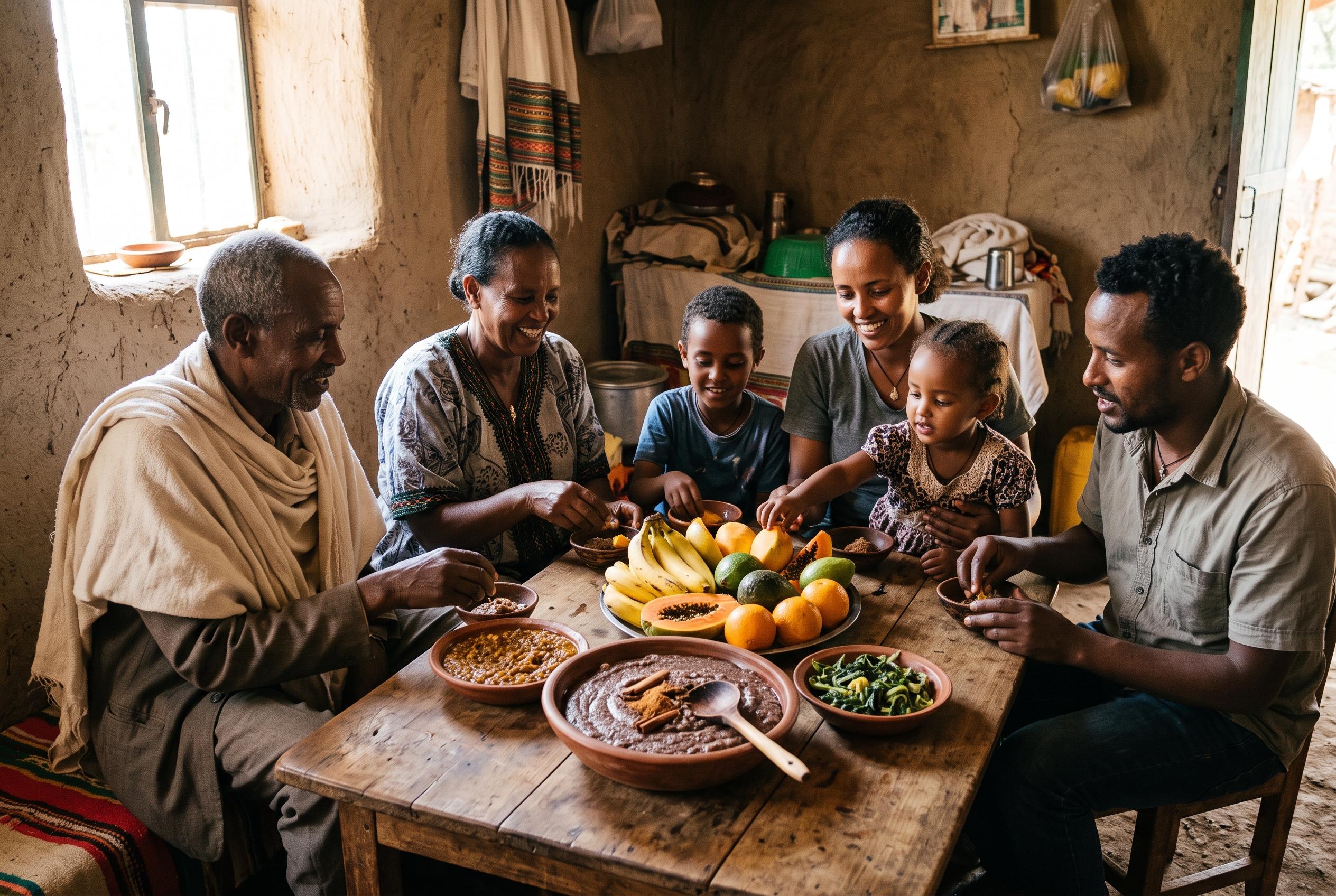

A new national analysis reveals Ethiopia’s reliance on cereals limits access to nutrient-rich foods like fruits, vegetables, and pulses, highlighting the need for policy shifts to foster dietary diversity and improve nutrition.
Ethiopia’s farms produce plenty of calories, but not enough of the foods that make for a balanced diet, according to a new national analysis published in the Journal of Agriculture and Food Research. The study found that cereals dominate the country’s fields and food supply, while fruit, vegetables, pulses and nuts are grown in far smaller quantities than national dietary advice calls for. Ethiopia’s food-based dietary guidelines, issued in 2022, were designed to improve diet quality, diversity and food safety for people aged two and above, with support from the Ethiopian Public Health Institute and international partners including the FAO and Wageningen University and Research.
The research team, led by Ruth Bekele Mijena of Wageningen University & Research, compared national crop production with both Ethiopia’s own dietary guidelines and the EAT-Lancet reference diet. They used the latest consistent national agricultural data available for 2021 and examined output across smallholder and commercial farms. The result was a picture of a food system built around cereals, with wheat, maize, teff, barley and sorghum carrying most of the burden of feeding the population. A 2022 review of Ethiopian cereal and grain legume yields helps explain why: even when production rises, yields remain well below potential because improved varieties are not widely adopted and farm management remains suboptimal.
The mismatch was stark. Cereals took up most of the cropland and produced more than enough energy, but other plant foods lagged badly behind dietary need. Under the national guidelines, pulses met only about half of recommended levels, vegetables fell well short, and fruit production was especially low. Against the EAT-Lancet benchmark, the imbalance was even clearer: whole grains and starchy roots were grown in large surplus, while vegetables, fruit, nuts and unsaturated oils fell far short. The study also suggests that Ethiopia’s emphasis on cereal self-sufficiency has long been reinforced by policy, input subsidies and a market system that favours staple grains over more diverse crops.
Nutrient analysis showed that crop output could cover the country’s energy needs and supply most of the nutrients examined, but not all of them. Vitamin A was the biggest gap, followed by vitamin E, fat and calcium. The authors noted that fruits and vegetables contributed disproportionately to vitamin C, while root crops added some vitamin A and vitamin E because they are grown in such large volumes. Their modelling also suggested that if cereal production were capped at the level needed to meet energy demand, millions of hectares could be redirected towards more nutrient-rich crops. Even so, the authors cautioned that such a shift would depend on water, markets, infrastructure and farmers’ ability to adapt.
The broader implication is that Ethiopia’s challenge is not simply to grow more food, but to grow the right mix. The study points to home gardens, enset-based agroforestry and better support for diversified farmers as practical ways to improve diets without abandoning staple production altogether. It also argues for stronger storage, transport, credit and crop insurance systems, as well as better coordination of nutrition-sensitive agriculture policy. In a country where a large share of households still cannot afford a healthy diet, the authors conclude that the path to better nutrition may begin with a less grain-heavy landscape.
Disclaimer: This content is for informational purposes only and is not intended to be a substitute for professional medical judgment, advice, diagnosis, or treatment.