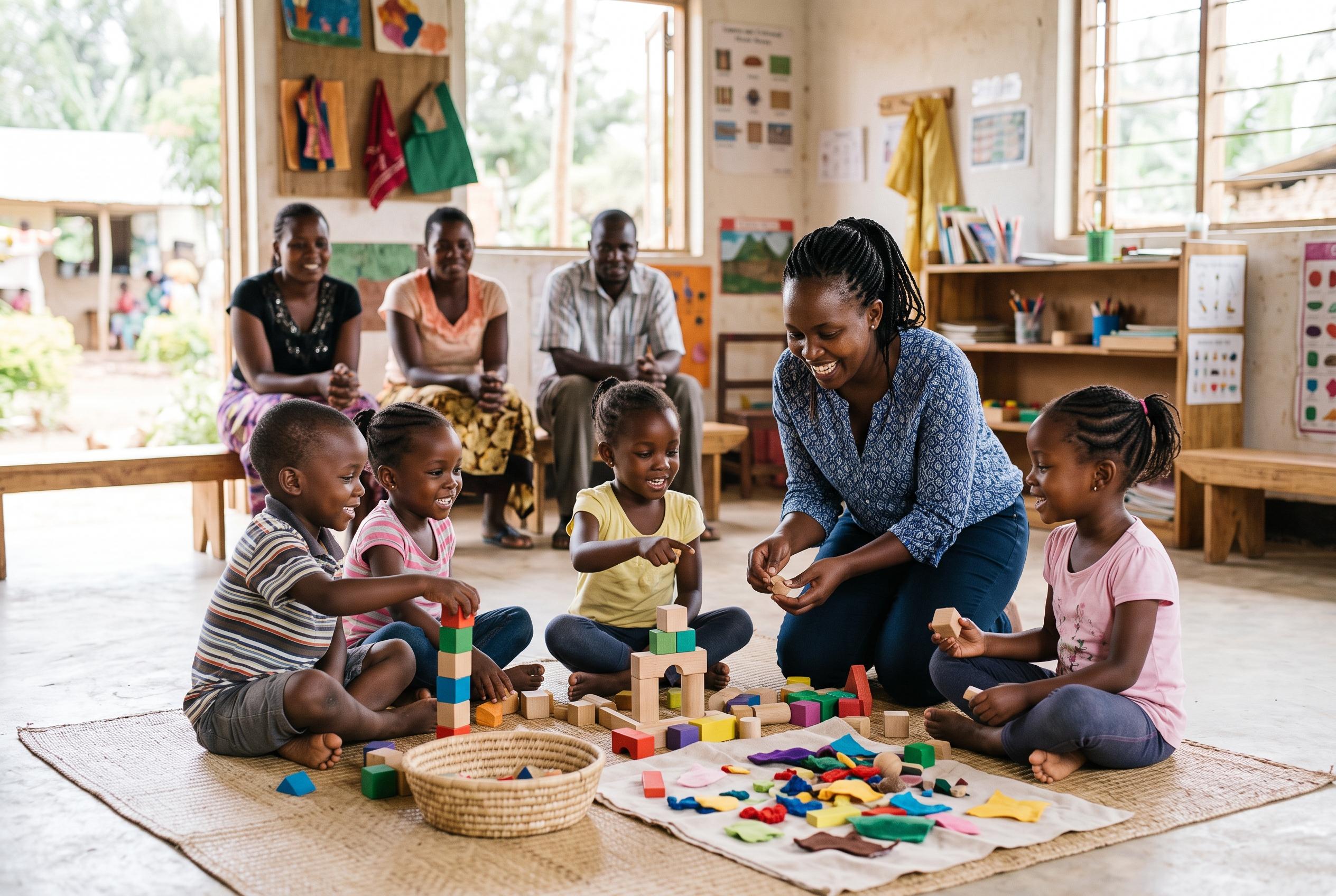

Recent studies across African countries highlight that expanding nursery and kindergarten access alone is insufficient; sustainable improvements depend on classroom quality, teacher training, emotional support, and family engagement, offering critical insights for policymakers aiming to boost early childhood outcomes.
African governments racing to widen access to nursery and kindergarten are being urged to worry as much about what happens inside classrooms and homes as about how many seats they create. A 2026 systematic review by economists Subha Mani and Katherine Theiss, published in the Journal of African Economies, examined six experimentally evaluated pre-primary programmes for children aged three to six in African low- and middle-income countries and found average gains in cognitive outcomes of 0.10 standard deviations. The broader message from the evidence was that access matters, but quality, coaching and family engagement often decide whether children benefit. (ideas.repec.org)
The review drew on programmes in The Gambia, Ghana, Kenya, Malawi and Mozambique, with two studies from Ghana, and tracked outcomes roughly one to two years after interventions began. UNICEF’s wider evidence review across low- and middle-income countries points in the same direction: play-based and child-centred teaching tends to produce better results when training is sustained over time, rather than delivered as a one-off course, and when teachers receive ongoing support in day-to-day practice. (ideas.repec.org)
Some of the clearest operational detail comes from rural Ghana, where one evaluation followed pre-primary schools in Bongo District in the Upper East Region and Tolon District in the Northern Region. According to IPA, researchers working with the Institute for Fiscal Studies and Lively Minds studied 80 rural schools, with half assigned to receive support and half used for comparison. The programme did more than hand teachers a manual: Ghana Education Service district teams were drawn in to build local ownership, while two kindergarten teachers in each school were trained in classroom management, play, making games and coaching volunteer mothers. The setting helps explain why that mattered. IPA noted that rural schools were grappling with large classes, absenteeism, weak play resources and rote teaching, while median educational attainment for women in 2014 was reported at zero years in the Northern Region and 2.9 years in the Upper East, against a national average of 7.2 years. (poverty-action.org)
A separate Ghana intervention suggests that teacher support can have effects beyond the classroom atmosphere. IPA reported that in-service training and coaching improved teachers’ use of the play-based pedagogy set out in Ghana’s national kindergarten curriculum, reduced burnout and cut teacher turnover in the private sector. It also improved children’s early literacy, early numeracy and social-emotional development in the first year; one year later, after children had moved on, the social-emotional gains persisted, and preliminary evidence two years later pointed to sustained gains in literacy, executive function and behavioural regulation. UNICEF’s review adds an important qualification: the strongest persistence in Ghana was seen in classrooms where teachers offered higher levels of emotional support, suggesting that the manner of teaching matters as much as the lesson plan. (poverty-action.org)
The evidence on parent outreach is more complicated than a simple “more is better” story. UNICEF’s review says that in Malawi, researchers thought teachers’ extra practice in running parenting sessions may explain why positive child impacts appeared only when workforce development and family engagement were combined. But the same review also says improvements in classroom practice in Malawi did not automatically translate into statistically significant gains in child outcomes, and that benefits seen at 18 months were no longer evident at the 36-month follow-up. In Ghana, UNICEF says an awareness-raising campaign for parents by itself had no measurable effect on children’s development outcomes. It also records later follow-up findings from the Ghana project that were weaker, or even negative, in classrooms with lower emotional support and among some more disadvantaged households. (unicef.org)
Mozambique offers one of the strongest cases for combining access with structure and community involvement. A World Bank case study of the country’s Community-Based Preschool Program says villages seeking support had to provide land, some building materials and labour, and set up committees to manage the schools. Each class had two volunteer teachers, backed by training, monthly coaching visits and mentoring, while parents and teachers attended parenting meetings. The programme, piloted in 2005, expanded to 30 communities in 2008 and to five provinces in 2012, later reaching 600 communities. The World Bank says it cost US$2.47 per child per month, or roughly US$20 to US$30 a year per pupil, and lifted pre-school enrolment among three- and four-year-olds by 43.9 percentage points. Children in the programme recorded a 14.6-point increase on the Ages & Stages Questionnaire, were 10.2 percentage points more likely to enter primary school at the right age, and parents attending monthly meetings were 21 percentage points more likely to practise daily routines with their child and 6.2 per cent more likely to have worked in the previous 30 days. (documents.worldbank.org)
In The Gambia, the policy debate has already moved beyond whether to expand enrolment and towards which model offers the best return. UNESCO’s education planning institute says the government, under its 2016-2030 Education Sector Strategic Plan, wants gross pre-primary enrolment to reach 75 per cent by 2030, even though “barely one child in two” is currently enrolled. Its analysis looked across five different types of provision: government, private, Madrasa, community-based and mission centres. Diane Coury, the report’s author, said the work had identified “areas that require urgent attention”, including the lack of classroom materials and the training needed to use them well. UNICEF’s wider review adds that Gambian evidence has shown some benefits concentrated among the most disadvantaged children, including gains in fine motor skills among those starting furthest behind and among children whose mothers were experiencing mental health difficulties. (iiep.unesco.org)
That leaves policymakers with a tougher, but more useful, conclusion than simply building more pre-schools. The African evidence base is still small, and UNICEF notes that fewer than half of the studies it reviewed reported overall cost or per-child spending, making scale-up decisions harder. Even so, the material now emerging from countries such as Mozambique and The Gambia suggests that spending decisions can be judged on more than enrolment counts alone: teacher selection, coaching intensity, emotional support in classrooms, and meaningful work with caregivers all appear to shape whether early gains last. (unicef.org)
Disclaimer: This content is for informational purposes only and is not intended to be a substitute for professional medical judgment, advice, diagnosis, or treatment.