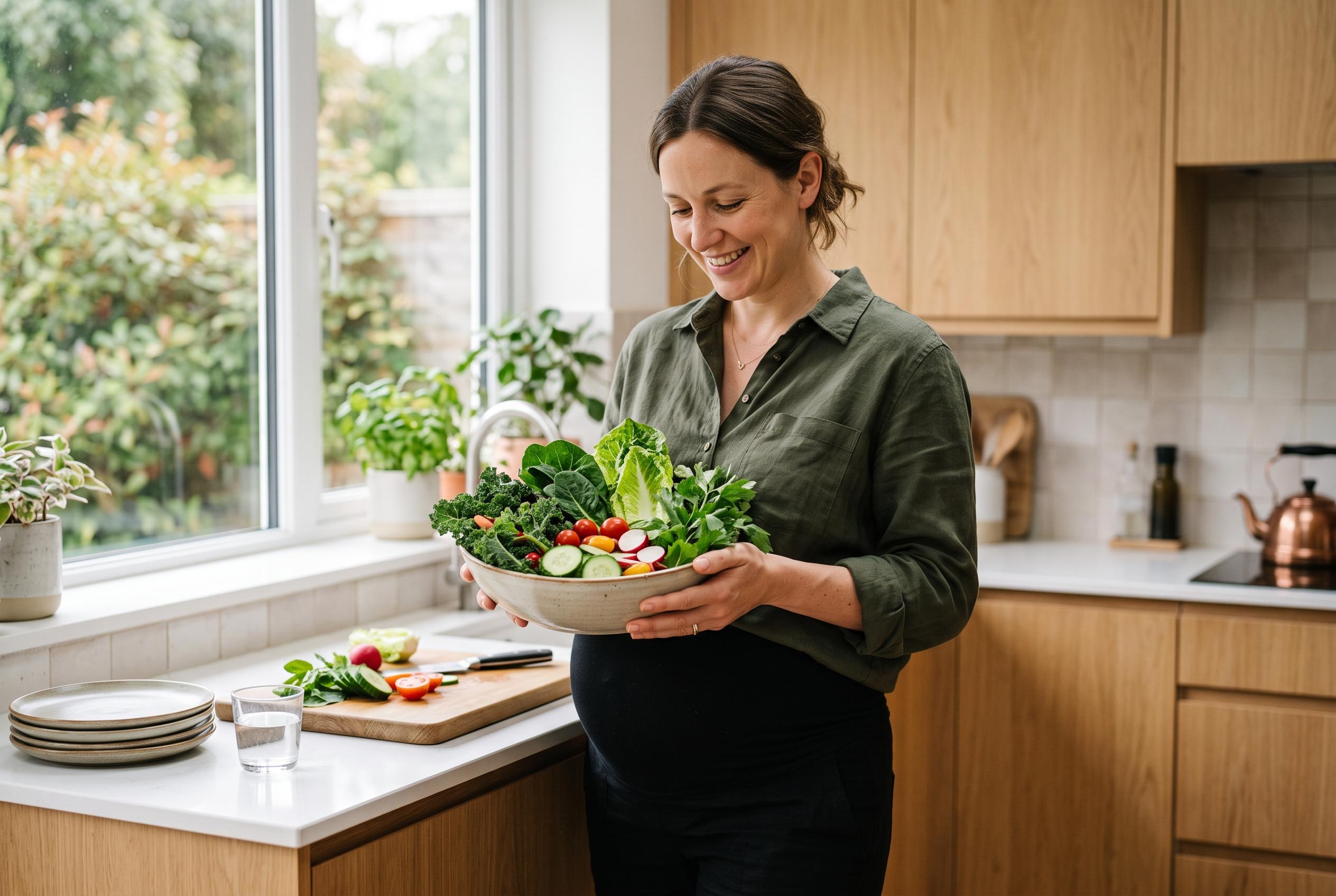

New research from Germany highlights how different dietary patterns during pregnancy may impact gestational length and newborn size, with vegetable-rich diets linked to longer pregnancies and lengthier babies, while ultra-processed foods correlate with higher maternal weight gain.
Pregnant women whose diets were richest in vegetables in a long-running German cohort tended to give birth after slightly longer pregnancies and to babies who were longer at birth, while a separate eating pattern dominated by ultra-processed foods was linked to a heavier maternal starting weight and greater weight gain during pregnancy. In the European Journal of Clinical Nutrition, (nature.com) researchers from Leipzig reported that these differences emerged when they sorted expectant mothers into four distinct diet groups rather than looking at single nutrients in isolation. (nature.com)
The paper does not argue that diet alone caused those outcomes. The authors described the work as “exploratory”, (nature.com) and News-Medical’s account of the study stressed that the newborn effects were modest and that several headline measures, including whether babies were small or large for gestational age, did not differ enough between groups to rule out chance. (news-medical.net) That caution matters because the cohort had relatively few adverse birth outcomes, something the journal article itself says may have reduced the study’s power to detect clearer differences. (nature.com)
The analysis drew on 1,404 pregnant women in the LIFE Child cohort in Germany, with newborn data available for 1,196 infants, collected between February 2011 and January 2025. In the study methods, (nature.com) the team said women filled in a food frequency questionnaire at either the 24th or 36th week of pregnancy, covering what they had eaten over the previous four weeks. The researchers then used Ward’s hierarchical clustering method to sort food-frequency data into broader patterns, first creating nine food-item groupings and then four maternal diet clusters: mixed-diet, traditional bread-based, high-UPF and vegetable-rich. A JoVE visual abstract summarising the work identified the lead affiliation as Leipzig University’s Medical Faculty and its Centre for Pediatric Research at the University Hospital for Children and Adolescents. (nature.com)
The sharpest differences appeared in the mothers rather than the babies. Women in the high-UPF group, meaning a pattern heavier in industrially formulated foods and snacks, were younger, had the lowest socioeconomic scores, entered pregnancy with the highest pre-pregnancy body mass index and put on the most weight over the second and third trimesters. (nature.com) By contrast, the vegetable-rich group was older, had the highest socioeconomic status and the lowest pre-pregnancy BMI, while the traditional bread-based group had the highest parity, meaning more previous births. (nature.com)
For infants, the picture was more restrained. Average birth weight did not differ significantly between the four diet groups, (nature.com) but the vegetable-rich pattern was associated with the longest gestations on average and the greatest birth length compared with selected other groups. After adjustment for maternal age and education, (nature.com) the apparent gestational-age advantage weakened, while the birth-length difference remained against both the bread-based and mixed-diet groups. Overall, 4.4% of babies were classed as small for gestational age and 11% as large for gestational age; the highest small-for-gestational-age rate, 6.1%, was in the high-UPF cluster, but the differences were not statistically convincing. (nature.com) NCBI’s MedGen database has already indexed the paper under “Appropriate for Gestational Age”, reflecting the study’s focus on whether babies fell below, within or above the expected weight range for their stage of pregnancy. (ncbi.nlm.nih.gov)
The authors said the observed neonatal effects were “generally small and should be interpreted with caution”. (nature.com) They also set out several reasons not to over-read the findings: diet was captured only once during pregnancy, the questionnaire relied on self-reporting, and unmeasured factors such as stress or sleep may still have influenced the results. The paper added that the cohort consisted of German women, which may limit how far the findings travel to populations with different food cultures or economic circumstances, and warned that false-positive results cannot be excluded because of the number of comparisons made. (nature.com)
The study had been circulating in an earlier form before journal publication. A conference abstract at the 18th Leipzig Research Festival for Life Sciences in 2025 described the same project using 1,325 mother-child pairs and linear and generalised linear models, suggesting the dataset expanded and the analysis was refined before the final paper appeared. (uniklinikum-leipzig.de) Leipzig University’s LIFE Child publications register now lists the article, published online on 2 September 2026, among the programme’s wider perinatal and paediatric research output, and NCBI records it as PMID 42686921. (home.uni-leipzig.de) For clinicians and expectant families, the practical message is less that one menu guarantees one outcome than that broader eating patterns appear to travel with age, weight, social circumstances and, perhaps in more limited ways, early measures of infant growth. The authors said their results were “supporting the critical importance of early nutritional information in pregnancy care”. (nature.com)
Disclaimer: This content is for informational purposes only and is not intended to be a substitute for professional medical judgment, advice, diagnosis, or treatment.