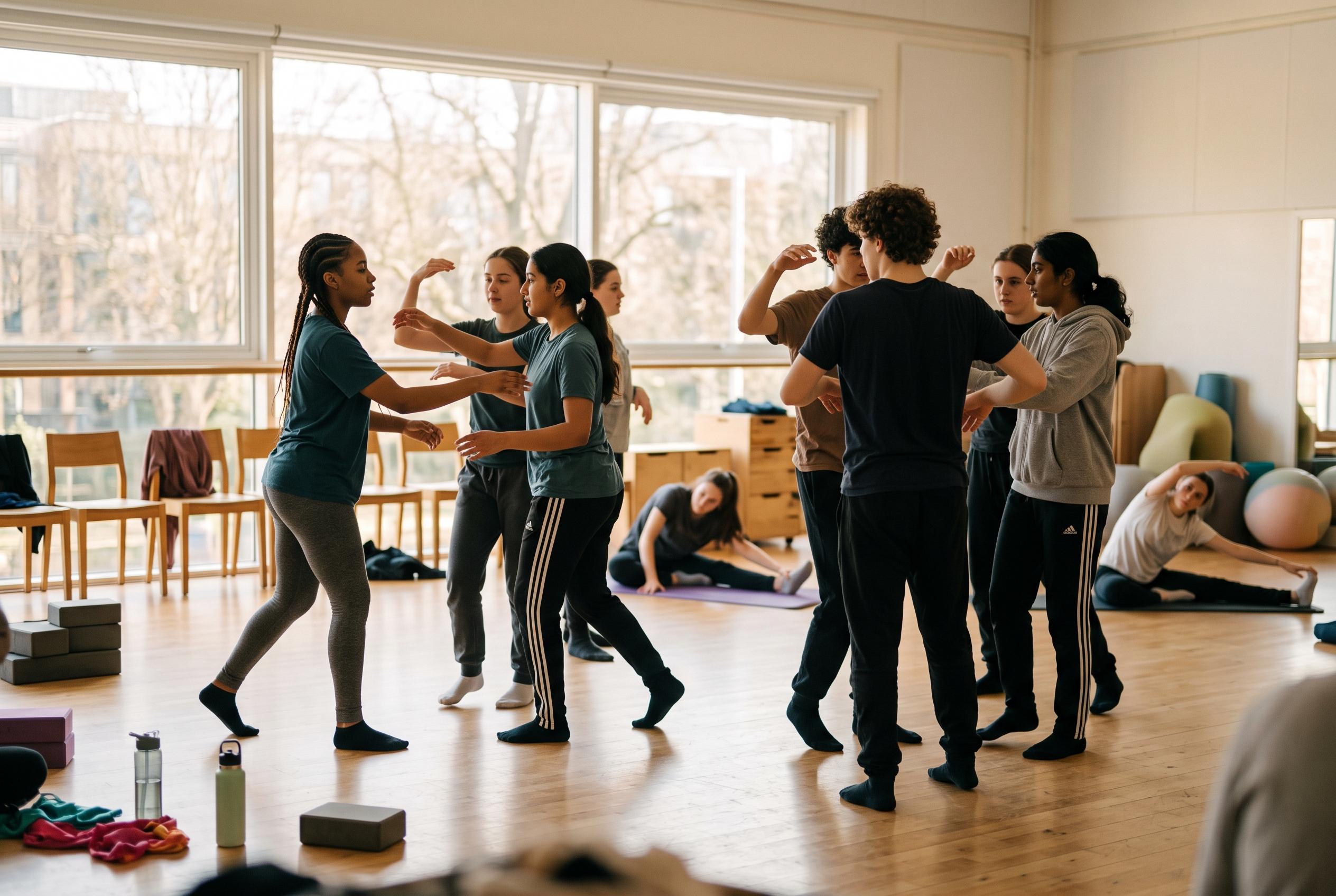

The Share Foundation’s newly expanded Stepping Forward: Explore programme broadens access to performing arts for all youth, while maintaining targeted support for care-experienced children, amid rising pressure on arts funding in schools.
A performing arts course first created for children in care is being opened up to a far wider audience, with The Share Foundation now offering its Stepping Forward programme to young people through schools, youth groups or at home as arts provision comes under growing pressure. The expanded version, Stepping Forward: Explore, is being sold as a flexible digital course for all learners, while the charity says eligible young people in care will continue to use the original scheme free and keep the chance to earn money into long-term savings.
The broadened offer builds on a project that began as a more targeted intervention for care-experienced teenagers. Tring Park School for the Performing Arts in Hertfordshire developed the original course with The Share Foundation and the Rothschild Foundation for 13- to 17-year-olds, and planning dates back to the summer of 2023. Reporting from October 2024 said scripts and filming for the six-part series had been completed over the previous three months, with guidance from a focus group of young people in care and an advisory group chaired by Andy Wright OBE. The Rothschild Foundation later said the programme formally launched on Friday 28 February 2025.
By the time the foundation published its 2024/25 grants review, 13 local authorities were already offering Stepping Forward to young people with care experience, with more expected to follow. The same review said the course was designed not only to introduce pupils to performing skills and backstage roles, but also to signpost them towards local cultural organisations and future opportunities. It added that the programme could count towards Arts Award, giving it a clearer educational pathway than many one-off enrichment schemes.
Its structure is broader than a conventional drama course. Development material described a six-stage journey covering acting, singing, dance and backstage arts, with participants moving from an introduction to the sector through specialist workshops, professional interviews and advice on next steps. Contributors named during the rollout included Emeka Sesay, Zoë Lister, Pandora Christie, Mo Jamil and soprano Jennifer France. Later publicity around the public version placed extra emphasis on lighting, stage direction and technical theatre, alongside videos, quizzes and workshop exercises intended to make the course accessible to young people who may never have thought of themselves as performers.
The charity’s pitch is closely tied to the worsening state of arts access in schools. In promoting the wider launch, The Share Foundation cited research from Child of the North and the Centre for Young Lives saying that 93 per cent of UK pupils are missing out on arts education because of underfunding, and that participation in extracurricular arts activity has fallen since the pandemic. Against that backdrop, the public version is priced at £30 per pupil, with discounts for group purchases, and the charity says the income will be reinvested in the original free offer for young people in care.
For Chris Kenna, a trustee of The Share Foundation, the case for the programme is also personal. “As a care leaver myself, I know the transformative power of the arts,” he told Smiley News, arguing that creative work can help young people build a base for education, employment and emotional wellbeing. Josie Rylance, the project’s co-ordinator, has said the expanded course was designed to give young people safe and accessible opportunities for self-expression, confidence-building and social connection, while also helping to reduce anxiety and develop life skills that extend well beyond the arts.
The original version remains more tightly defined. Guidance circulated by Slough Borough Council and updated on 28 January 2026 said young people should register with their own email address and, in that authority’s case, normally need to have been in care for at least 12 months so their eligibility can be checked. That reflects the programme’s place inside The Share Foundation’s wider work on Child Trust Funds and Junior ISAs for looked-after children. In a Share Radio commentary published on 3 March 2025, chair of trustees Gavin Oldham said performing arts could give young people transferable skills and the “enjoyment of working together with others”. The same charity network has said more than 100,000 young people have already been helped to claim almost a quarter of a billion pounds from Child Trust Funds.
There is also an attempt to create progression beyond the online lessons themselves. The Rothschild Foundation said it had backed the project with a two-year bursary at Tring Park sixth form for a student from a low-income or care-experienced background, tying the scheme to a concrete route into further training. Simon Larter-Evans, Tring Park’s principal during the development phase, called the course “just the beginning”. One focus-group participant, Khia, described the trial as “an amazing experience”, saying it had boosted confidence and revealed talents they had not recognised before. At a time when arts teaching is increasingly hard to protect in mainstream education, that mix of access, aspiration and practical support is central to how Stepping Forward is now being presented.
Disclaimer: This content is for informational purposes only and is not intended to be a substitute for professional medical judgment, advice, diagnosis, or treatment.