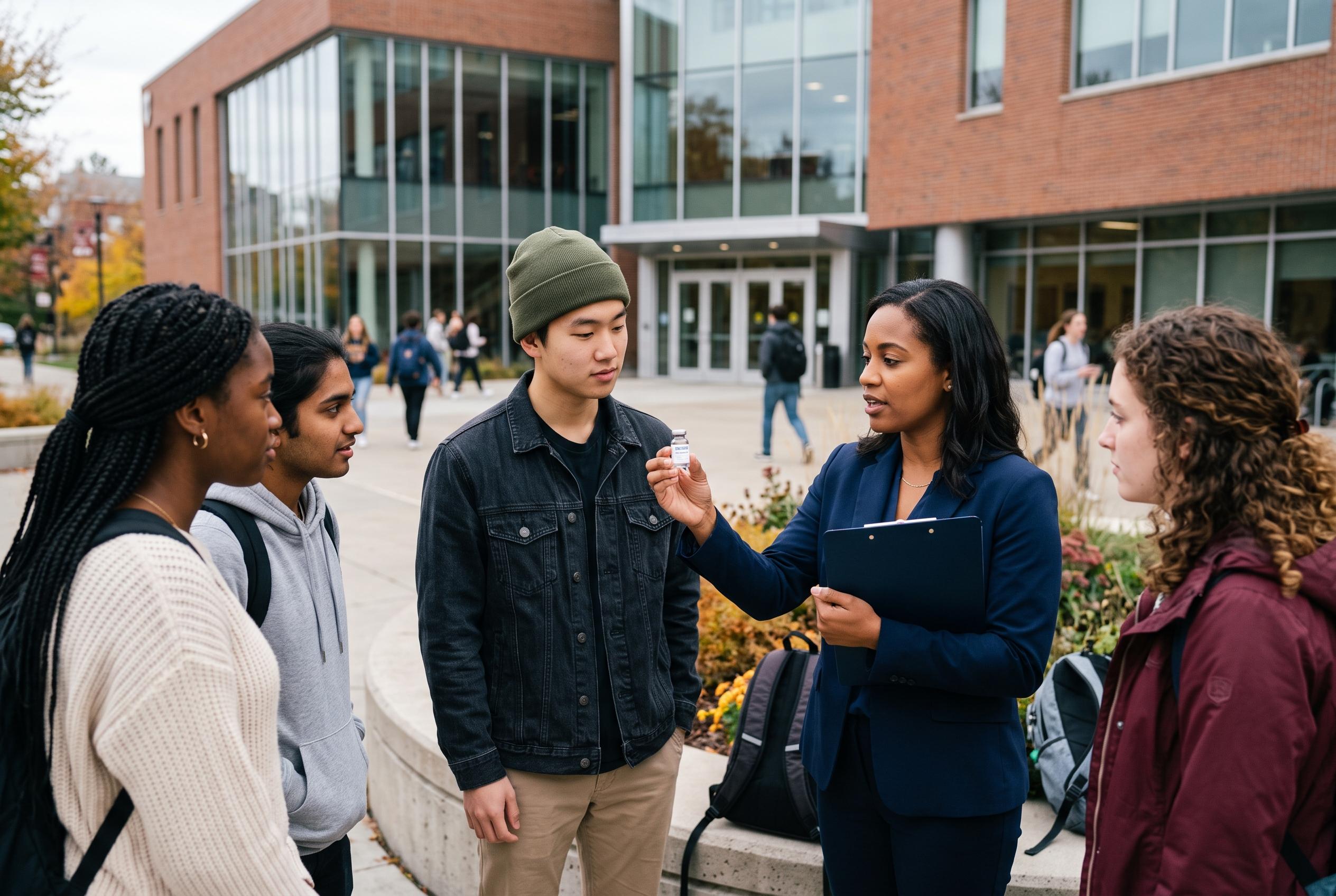

A surge in meningococcal B cases at the University of Kent has led to a national campaign to vaccinate teenagers and first-time students ahead of the 2026-2027 academic year, as authorities respond to the largest outbreak of its kind in the UK.
England’s response to the Kent meningitis outbreak has widened into a national push to vaccinate older teenagers and first-time students against MenB ahead of the 2026 to 2027 academic year, while ministers consider whether the jab should become a routine offer for adolescents. The NHS says the temporary scheme runs until March 2027, and it follows an outbreak that officials later described as the fastest-growing and largest of its kind seen in the UK. (nhs.uk)
The scale of what happened in Canterbury helps explain the urgency. Associated Press reported that the first case was confirmed on Friday 13 March 2026 and the total had climbed to 20 by the following Wednesday, prompting Health Secretary Wes Streeting to call the outbreak “unprecedented”. UKHSA’s later count put the final figure at 21 confirmed cases linked to Canterbury by 1 April, all of them MenB, all hospitalised, with two deaths. Most of those affected were linked to the University of Kent and local sixth forms. (apnews.com)
Public health officials moved first with antibiotics, then with targeted vaccination. UKHSA said around 5,000 students living or working in halls at the University of Kent’s Canterbury campus would be offered MenB vaccination, while advice went out to 16,000 staff and students and antibiotics were made available through university sites and community venues including Westgate Hall and the Gate Clinic. The agency stressed that the MenACWY jab routinely given to teenagers does not protect against MenB, and that MenB vaccination helps prevent illness but does not stop people carrying and spreading the bacteria, which is why antibiotics remained central to the immediate response. (gov.uk)
That outbreak also exposed the limits of private supply. Reuters reported that demand for MenB vaccination surged in south-east England and beyond, with students queueing for up to eight hours at a University of Kent vaccination centre. Pharmacies said they had been inundated, Boots and Superdrug introduced waiting lists, and the government released 20,000 NHS doses into the private market to ease shortages. The Guardian reported that private injections were costing £100 to £120 a dose, or about £200 to £240 for the required two-dose course, with Boots charging £220. (lse.co.uk)
The human toll is clearer in the account of Annabelle Mackay, a 21-year-old law student at the University of Kent. The Standard said she had been celebrating her birthday after visiting Club Chemistry and another venue in Canterbury when she fell ill days later. On 11 March, with a high fever, light sensitivity and a stiff neck, she called NHS 111 and was told to stay at home after a 16-minute assessment. “When the 111 woman told me to stay home, I was like, ‘Are you sure?’ But she told me to stay put and drink water,” she said. Mackay later told the paper she would “be dead if it wasn’t for my mum and housemates” after deteriorating so badly she had to be carried to a car before hospital doctors diagnosed meningitis. (standard.co.uk)
Other reporting showed how widely the investigation quickly spread. UKHSA said some cases had visited Club Chemistry between 5 and 7 March, while official clinical guidance later said at least 10 cases had attended the nightclub on one of those dates. The Guardian reported that French health authorities alerted Britain to a second confirmed case in France involving a student who had attended the University of Kent, and that another affected student travelled to London before seeking treatment there. It also named one of the two people who died, an 18-year-old sixth-former from Faversham whose parents asked for her to be identified only as Juliette. There was some disagreement over terminology: the Guardian reported that the episode was being handled as a national rather than local incident from the start, while Streeting later said it was a nationally managed response, not a formal “national incident” on the scale of Covid. (theguardian.com)
For parents and students, the practical message remains brutally simple: do not wait for every symptom to appear, and do not assume it is flu, a cold or a hangover. UKHSA says meningococcal disease can worsen rapidly and warns of fever, headache, rapid breathing, drowsiness, shivering, vomiting and cold hands and feet; septicaemia can also cause a rash that does not fade when pressed with a glass. Streeting told MPs that the bacteria does not spread easily in passing contact, but is more likely after prolonged close contact such as living together, prolonged kissing, or sharing drinks and vapes. (gov.uk)
The current national offer gives that warning a more concrete timetable. According to the NHS, two doses are needed for protection, with first doses available until 31 December 2026 and second doses until 31 March 2027. Those automatically eligible include young people born between 1 September 2007 and 31 August 2008, as well as people born on or after 21 July 2001 who are starting university or certain residential further-education courses for the first time in autumn 2026. The policy debate, however, has moved beyond this autumn’s catch-up. After the Kent outbreak, Reuters reported growing calls for broader adolescent access to MenB vaccination; in July, the JCVI went further and recommended a routine offer at around age 15 for teenagers who had the infant programme, while also backing two-dose offers for older cohorts on equity grounds. The government has yet to say whether that advice will become permanent policy. (nhs.uk)
Disclaimer: This content is for informational purposes only and is not intended to be a substitute for professional medical judgment, advice, diagnosis, or treatment.