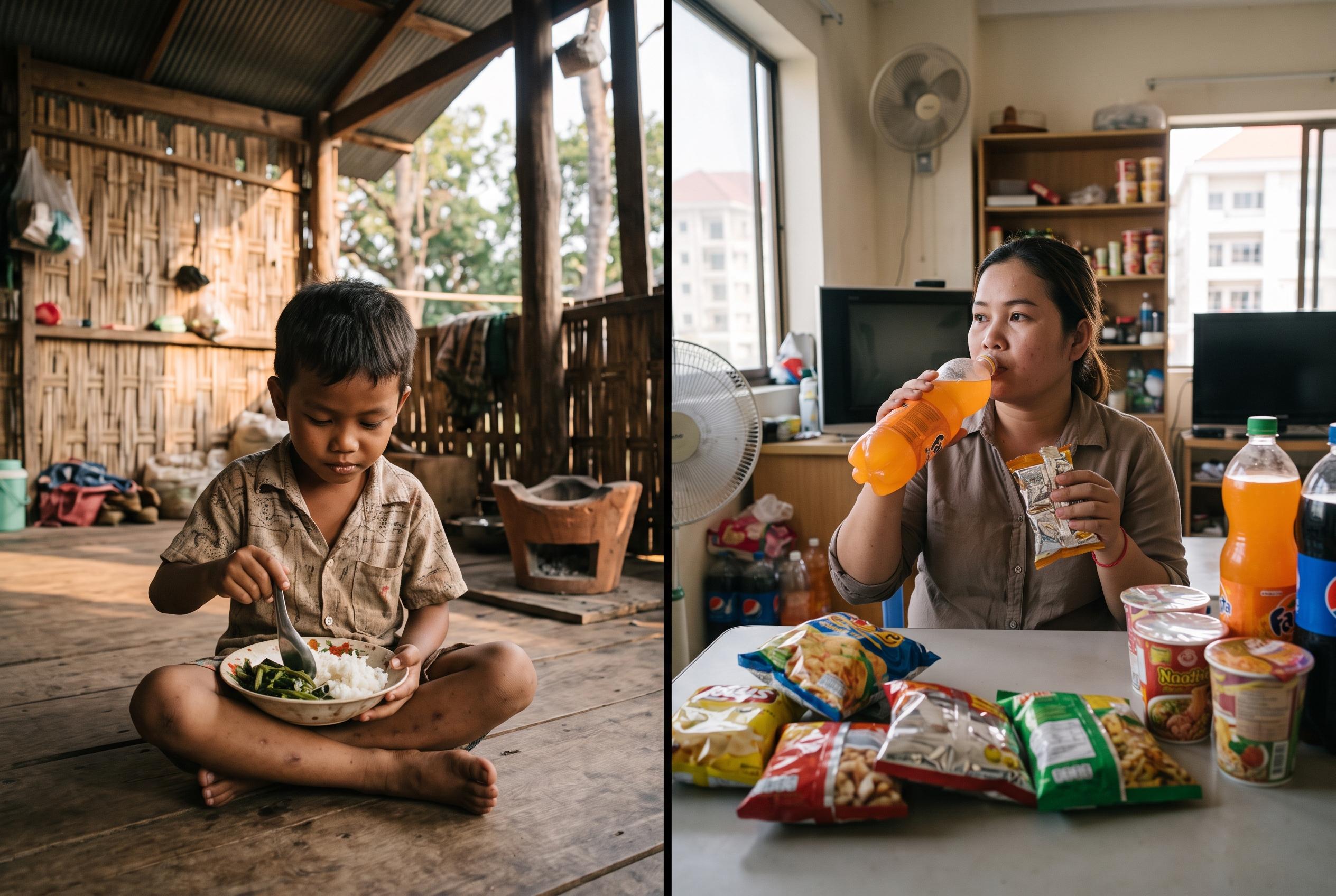

Cambodia is experiencing a shifting public health challenge, battling both undernutrition among children and a surge in diet-related non-communicable diseases among adults, driven by changing food habits and increased marketing of ultra-processed foods.
Cambodia’s public-health challenge is no longer only about not having enough to eat. The country is now contending with undernutrition and a fast-growing burden of diet-related disease at the same time. The World Health Organization said in March 2025 that non-communicable diseases are the leading cause of death in Cambodia, causing about 60,000 deaths a year, while its latest STEPS survey found adults consuming 9.5 grams of salt a day on average, nearly twice the WHO limit, and identified substantial levels of diabetes, raised cholesterol and stroke risk. At the same time, UNICEF says 22 per cent of children under five are stunted and 10 per cent are wasted. (who.int)
That collision of old and new nutrition problems is unfolding as Cambodian diets become more commercialised, more convenient and more heavily marketed. Dr Sanne Sigh, a nutrition researcher who has worked in South-East Asia for 12 years, told Khmer Times that the real danger is not the occasional treat but the routine drift towards foods high in sugar, salt and fat. “Calories is one thing, nutrients is another thing,” she said. UNICEF has drawn the same picture more broadly, saying traditional diets based on fresh ingredients are being squeezed by ultra-processed foods, sugary drinks, packaged snacks and instant meals, while children encounter junk-food marketing online, on the journey to school, on television and in shops. (unicef.org)
The shift matters most for children because poor food habits are being formed early. UNICEF says fewer than half of Cambodian children aged six to 23 months, 42 per cent, receive a minimally acceptable diet. It also reports a “triple burden of malnutrition”: persistent undernutrition, continuing micronutrient deficiencies and rising overweight. Four per cent of under-fives are overweight, according to the agency, while 33 per cent of women aged 20 to 49 and 6 per cent of girls aged 15 to 19 are overweight or obese. Iron, zinc, iodine and vitamin D deficiencies remain widespread. (unicef.org)
Officials have been aware for years that sugary drinks are a visible part of the problem, especially in cities. WHO says consumption of sugar-sweetened beverages was already a growing concern in Cambodia by 2016, particularly in Phnom Penh. In 2017 the capital’s Municipal Health Department worked with the National Centre for Health Promotion and the Partnership for Healthy Cities on a city survey of knowledge and behaviour, then used the findings to shape a two-month television campaign, posters, school leaflets and workshops with community leaders and principals. The aim was not immediate legislation, WHO said, but to build public awareness and support for future policies that could curb the availability and affordability of such drinks. (who.int)
Research on how this plays out inside households is still thin, but one recent study suggests the story is more complicated than a simple replacement of traditional food with junk food. Preliminary findings from the Multisectoral Food and Nutrition Security project’s Nutrition Transition and Food Environment Study, based on a 2021 survey of 1,033 caregivers across 68 villages in Phnom Penh, Kampong Thom and Kampot, found clear urban-rural differences in where families get food. Rural households were far more likely to rely on their own fields, gardens, ponds and fishing, while urban households were more likely to buy from street vendors, wet markets, mini marts, restaurants and online. The researchers also found that, in their sample, less nutritious foods did not appear to be displacing healthier foods outright; instead they were often being eaten as well. Even so, the paper warned of “significant consumption” of energy-dense foods high in sugar and salt among both caregivers and children. (ennonline.net)
Broader national data point to why healthier eating is hard to sustain. A World Bank report based on the 2021 Cambodia Socio-Economic Survey found that the average diet is still dominated by rice, at 399 grams per person per day, with fruit and vegetable intake below the WHO recommendation of 400 grams a day. Fish is the main animal-source food at 103 grams a day, while milk, dairy products, legumes, nuts and seeds are described as nearly absent from the average diet. The report says rural households tend to eat more rice, vegetables and fish, whereas urban households consume more red meat and fruit. It also cautions that estimated sugar intake, at 12 grams a day, is probably understated because confectionery, juices and soft drinks are not fully captured in the survey. Meanwhile, per-person caloric availability of sugar and sweeteners rose by 61 per cent between 2010 and 2020. (documents1.worldbank.org)
Affordability is a central part of the story. UNICEF said in a 2023 release accompanying a national nutrition analysis that 16 per cent of Cambodian households cannot afford a nutritious diet, and that foods such as fruit, vegetables, legumes, dairy, eggs, fats and oils are not available in sufficient quantities to meet recommended consumption levels. The same analysis estimated an annual economic burden of US$1.5 billion, or 6.6 per cent of GDP, from inadequate diets and malnutrition in all its forms. It also warned that climate change could drive the cost of a nutritious food basket up by 10 per cent by 2030 and 20 per cent by 2050. “Good nutrition is the bedrock of child survival, growth, and development,” UNICEF’s Cambodia representative, Will Parks, said. (unicef.org)
That is why the debate in Cambodia is moving beyond advice to parents and towards the design of the food environment itself. UNICEF’s Fix My Food campaign is calling for stronger controls on digital and influencer marketing aimed at children, while the 2023 nutrition analysis proposed food fortification, social cash transfers, school feeding and regulation of unhealthy and ultra-processed foods and beverages. WHO’s latest warning on chronic disease risk adds urgency: Health Minister Chheang Ra said the 2023 STEPS survey showed the “significant impact that unhealthy lifestyles are having on the health of Cambodians”. Sigh’s prescription is simpler but points in the same direction: “make the healthier choice, the easier choice”. (unicef.org)
Disclaimer: This content is for informational purposes only and is not intended to be a substitute for professional medical judgment, advice, diagnosis, or treatment.