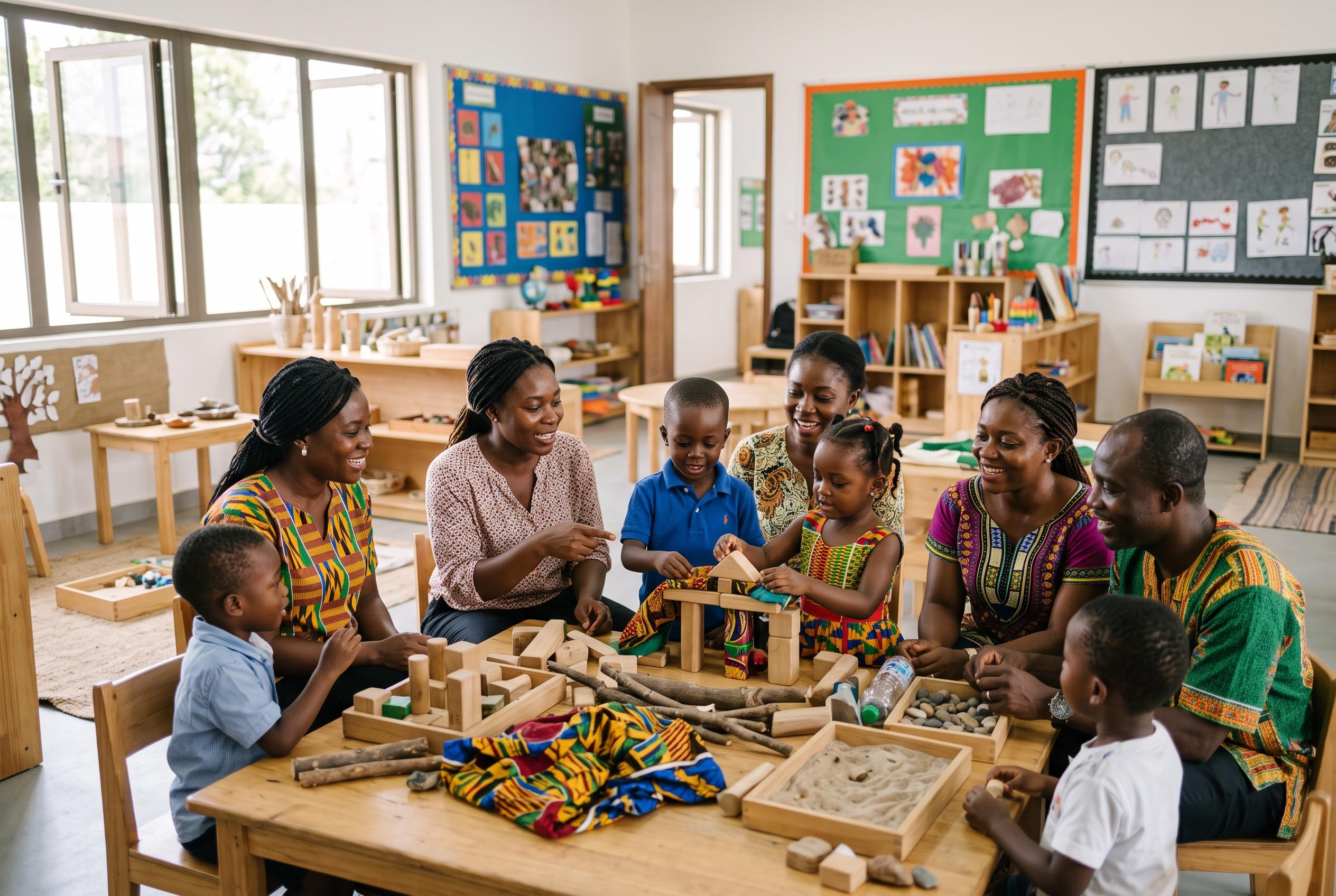

A review of preschool interventions across African countries reveals that improving classroom quality and family involvement yields more sustainable gains than simply increasing enrolment. Ghana’s holistic approach highlights the importance of investing in adults, teachers, parents, and community members, to ensure lasting early childhood benefits.
A review of preschool interventions in African countries is sharpening a point that ministers and donors often sidestep: getting more children through the door is not the same as giving them a good start. Across six rigorously evaluated programmes, the strongest results came not simply from expanding places, but from improving what happened in classrooms and, in several cases, from trying to shift what happened at home as well. That finding lands as Ghana pushes a broad early-years reform agenda. UNESCO says the country has trained 39,699 kindergarten teachers and district co-ordinators in a new curriculum across all 260 districts, while family and community engagement guidance has been piloted locally.
That wider systems picture matters because the evidence behind the review is not about one silver-bullet scheme. Ghana’s policy framework, as outlined by UNESCO, identifies weak co-ordination, inadequate teacher professional development, thin family engagement and patchy data as barriers to quality. Its response has involved a long cast list: the Ministry of Education, the Ministry of Gender and Social Protection, the Ghana Education Service, health agencies, the National Teaching Council, universities and organisations including UNICEF, Right to Play, Sabre Education and IPA. The review’s own conclusion sits squarely in that debate: play-based teaching, trained staff and meaningful work with families appear to matter more than headline enrolment figures alone.
One of the clearest tests came in Ghana’s Quality Preschool for Ghana initiative. According to a British Academy case study, the Ministry of Education rolled the programme out in 2015-16 across 240 schools in Greater Accra. Teachers received in-service training and coaching designed to bring play- and activity-based, child-centred methods into kindergarten classrooms. The programme also held parental-awareness meetings on the value of play-based learning and on strengthening contact between families and schools. The academy said the intervention improved children’s academic and social development and produced lasting gains in attention and behaviour after pupils had moved on to primary school.
However, later Ghana evidence suggests that parent components are not automatically beneficial, and may even backfire if they clash with what families think school should look like. A longitudinal study published in Developmental Science followed 3,435 children in 240 public and private preschools and found that teacher training on its own improved school readiness, with small effects still visible a year after the programme ended. But the version that added parental-awareness meetings did not produce the same gains. The paper reported lower scores for children in that combined arm than for children who received teacher training alone, particularly in literacy and numeracy, and said the negative effects were concentrated in households with non-literate male heads. The authors argued that some parents may have preferred more traditional, teacher-directed instruction. The British Academy case study drew a similar lesson, saying future reforms need to take parents’ own ambitions for children’s learning and socialisation seriously.
Malawi offers a different warning. The World Bank’s account of a trial in 199 community-based childcare centres describes a package that was more intensive than a simple training workshop: play and learning kits, five weeks of on-site mentoring for caregivers, small monthly attendance-linked cash incentives in one arm, and 12 parent group sessions in another. Those sessions covered early stimulation, nutrition, child health and developmental milestones. Yet the evaluation found that while some children improved after a year, the gains had disappeared by the time they reached primary school. The World Bank suggested one reason may have been the environment children entered next, including primary classes that could have more than 100 pupils for a single teacher.
Mozambique helps explain why governments keep trying despite that uncertainty. A World Bank brief on a pilot run by Save the Children in 30 rural communities in Gaza province found that preschool attendance lifted both participation and readiness for school. Children who attended were 24 per cent more likely to be enrolled in primary school after two years, spent an average of 7.2 extra hours a week on homework and classroom time, and recorded a 12.1 percentage point gain in cognitive skills. There were spillovers beyond the children in class: older siblings were more likely to be in school, and caregivers were more likely to be in work and less likely to see physical punishment as appropriate. “This whole (early childhood development) movement was a kind of awakening for our government,” Ines Tembe Magode, Mozambique’s chief of preschools, said in the World Bank brief. The ministry later used those results to support an expansion that reached about 84,000 children in 600 rural communities.
Another Ghana programme, Lively Minds, was built around the same question the review now raises: can quality survive scale? The BMJ Open protocol for its government-led evaluation notes that Ghana introduced early childhood care and development policies in 2004 and folded two years of public pre-primary education into the school system in 2007, helping drive universal net enrolment. Even so, the paper says about one-third of Ghanaian kindergarten children still lack the skills needed to thrive at school. The Lively Minds model tries to work on both sides of that gap by using teachers to train volunteer mothers, run parent workshops, improve hygiene and supervise structured play sessions. Its earlier efficacy trial found benefits for child health and for cognitive and socioemotional development. When the Ghana Education Service took ownership, the scaled version was designed to test whether fidelity of delivery, supervision by teachers and district offices, and the transfer from NGO control to state implementation would preserve those gains.
The lesson emerging from all of this is more demanding than the simple call to “invest early”. It is that early-years spending pays off only when governments invest in adults as well as children: in teachers who know how to teach young pupils, in volunteers and mentors who can keep programmes running, and in parents whose views are taken seriously rather than treated as an afterthought. Ghana’s own framework makes the point indirectly. UNESCO says it has coupled curriculum work with right-age enrolment campaigns, assessment pilots, family-engagement tools and 1,171 model kindergarten blocks under construction. The review gives that agenda an evidence base, but the country cases also show its limits: classroom quality can improve, home practices can shift, and children can gain, yet those gains are fragile if schools are weak, implementation drifts or families are not genuinely brought with the reform.
Disclaimer: This content is for informational purposes only and is not intended to be a substitute for professional medical judgment, advice, diagnosis, or treatment.