
As federal SNAP benefits decline across the US, Miami-Dade County’s removal of universal free breakfasts and lunches highlights growing concerns about the future of school nutrition programmes and the wider implications for child hunger nationwide.
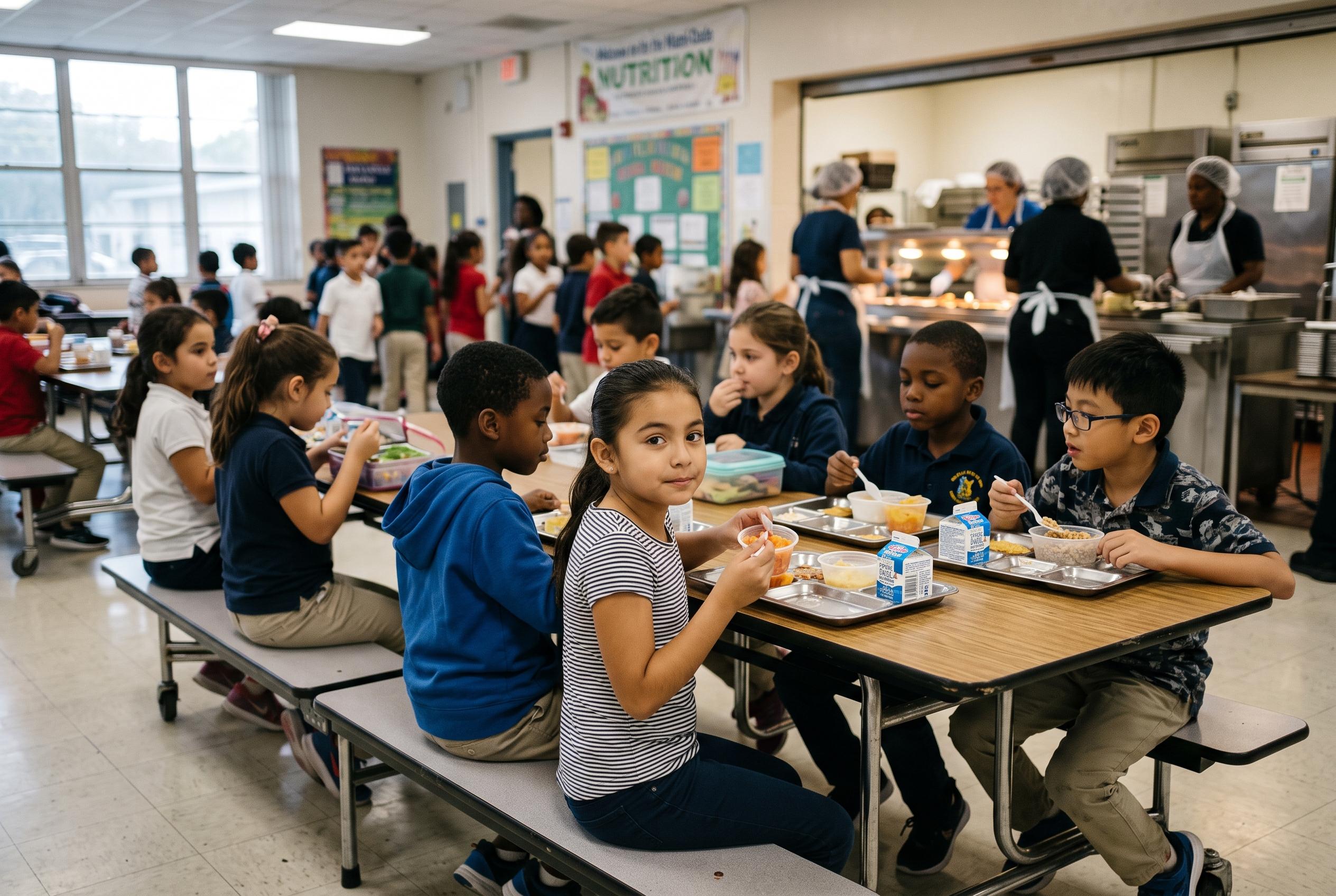
For many American families, the first clear sign that last year’s federal overhaul of SNAP is reaching the school gates has come in Miami-Dade County, where universal free breakfast and lunch have been withdrawn across most of the district. Only 121 schools still qualify to feed every child at no charge under the federal Community Eligibility Provision, while families at the rest must now apply individually for help. District officials have said all pupils would get meals free for the first 30 days of term, but after that a paid lunch costs $4.20, turning a technical funding shift into an immediate household expense.
What makes school leaders uneasy is that Miami-Dade may be an early example rather than an outlier. NPR, in a report carried by OPB, said more than 1 million children had lost SNAP since July 2025, when the One Big Beautiful Bill Act was signed into law. K-12 Dive, citing Food Research & Action Center estimates, said more than 5 million people nationwide have already lost the benefit. Because SNAP participation is used both to certify some children automatically for free meals and to calculate how much federal money a school can claim for serving everyone, falling caseloads can weaken meal programmes even where poverty itself has not eased.
The federal formula helps explain why officials think the effects may spread gradually. Under the Community Eligibility Provision, schools or districts need at least 25% of pupils to be counted through programmes such as SNAP or Medicaid to take part, and the federal government fully covers meals only once that identified-student share reaches 62.5%. NPR reported that more than 49,000 public schools were participating in 2024-25, while K-12 Dive said the total reached a record 55,362 schools in 2025-26, albeit with growth slowing sharply. Diane Pratt-Heavner of the School Nutrition Association told NPR: “This moment in time could potentially be a tip-of-an-iceberg situation.” She added: “It could get much, much worse.”
The formal answer from Washington is that losing SNAP does not automatically mean losing school meals. The US Department of Agriculture said in a statement reported by NPR that school meal programmes have their own income rules, and families who no longer receive SNAP may still qualify. But that safeguard depends on paperwork. CBS News reported that a family of four can still receive free school meals with income below $42,900, yet parents must document all sources of income, including government aid, on an application that can be especially hard to complete for households piecing together several jobs or variable hours. Pratt-Heavner told CBS News: “Our organization advocates for free meals for all, because so many children and families fall through the cracks of that application process.”
Schools are also braced for the financial aftershocks when universal meals disappear. CBS News reported that unpaid meal debt rose to $25.3 million last year, up 25% from 2024, and said food prices were 21% higher than in January 2022. NPR reported that when pandemic-era free meal waivers ended in 2023, some districts ran up debts as high as $1.7 million. It also said dozens of schools in places including San Antonio, Houston and Miami-Dade have already ended universal free meals. For administrators, that means not only more children facing charges at the till but also the return of collection work, unpaid balances and pressure on wider school budgets.
In Miami-Dade, the meal change is happening alongside wider disruption. Education Week and K-12 Dive reported that enrolment in Florida’s largest district fell 4%, from 326,279 pupils in 2024-25 to 313,220 in 2025-26, and that the board approved the closure or consolidation of nine schools for 2026-27. In a 30 July statement, chief operating officer Luis Diaz said “changing demographics, fewer newcomer students enrolling in our schools, and other enrollment trends” had altered the federal calculations used to determine eligibility. Axios reported that Florida posted the biggest decline in Community Eligibility Provision participation of any state in 2025-26, at nearly 10%, and that 82.7% of that drop came from just three districts: Broward, Duval and Pasco counties.
Another threat is that some families may stop engaging with the system even if their children remain eligible. K-12 Dive reported that a Department of Homeland Security rule finalised on 20 July could have a chilling effect on immigrant households if they fear free or reduced-price school meals, SNAP or Medicaid could count against them in immigration decisions. NPR separately reported concern among policy specialists that parents may become reluctant to share the personal information required on school meal forms, even though school meals are available to children regardless of immigration status. If fewer families sign up for the programmes used in direct certification, districts’ numbers for federal reimbursement could fall further.
Even in places with stronger state backing, school leaders are treating the issue as a front-line education problem as much as a hunger one. WXXI reported that 3,900 Monroe County households in New York had lost food assistance since May, sharpening attention on what children can reliably eat during the school day. Isaiah Santiago, a Rochester school board member, said: “Schools are going to become a place that our young people come for nutrition.” He also warned that access alone is not enough if meals go uneaten, saying: “It’s so important that we’re providing things they’ll eat,” and “things that they’ll enjoy.” That concern helps explain why advocates increasingly see the SNAP rollback not as a separate welfare story, but as the beginning of a wider test for school systems already being asked to do more with less.
Disclaimer: This content is for informational purposes only and is not intended to be a substitute for professional medical judgment, advice, diagnosis, or treatment.