
Nationwide Children’s Hospital in Columbus is integrating literacy assessments into routine pre-school check-ups, aiming to improve school readiness and address longstanding literacy disparities through innovative paediatric interventions.
Nationwide Children’s Hospital in Columbus is trying to turn the ordinary pre-school check-up into an early reading intervention. In a programme now embedded in several of its primary care practices, children aged three and four are given short literacy assessments during well-child visits, and families leave with tailored guidance, take-home materials and follow-up support. By July, the hospital was using the project to argue to peers across the sector that school readiness belongs inside paediatric care as much as in nurseries and classrooms.
The hospital’s case rests on bleak local and national numbers. Associated Press reported in February that more than 63% of Columbus City Schools kindergarteners were behind on language and literacy in the 2024-25 school year, according to Ohio kindergarten readiness data. Nationally, the same report said, just over 30% of US fourth-graders were rated proficient in reading on the 2024 National Assessment of Educational Progress, down four percentage points from 2019. The wire story, later carried by Fortune, also cited the Children’s Reading Foundation’s warning that nearly three-quarters of children who start in the bottom fifth on readiness measures are still there by fifth grade.
For Sara Bode, the hospital’s medical director of school-based health, that makes the clinic a missed opportunity if it sticks to broader developmental milestones alone. Nationwide Children’s says a primary care paediatrician could see a child as many as 15 times before kindergarten if American Academy of Pediatrics guidance is followed. Yet, as the hospital put it in a May explainer, current screening “doesn’t consistently capture” the specific early literacy skills children need when formal reading instruction begins. Education Week reported that the hospital has made kindergarten readiness one of its eight “paediatric vital signs”, a sign of how far it is trying to stretch the definition of child health.
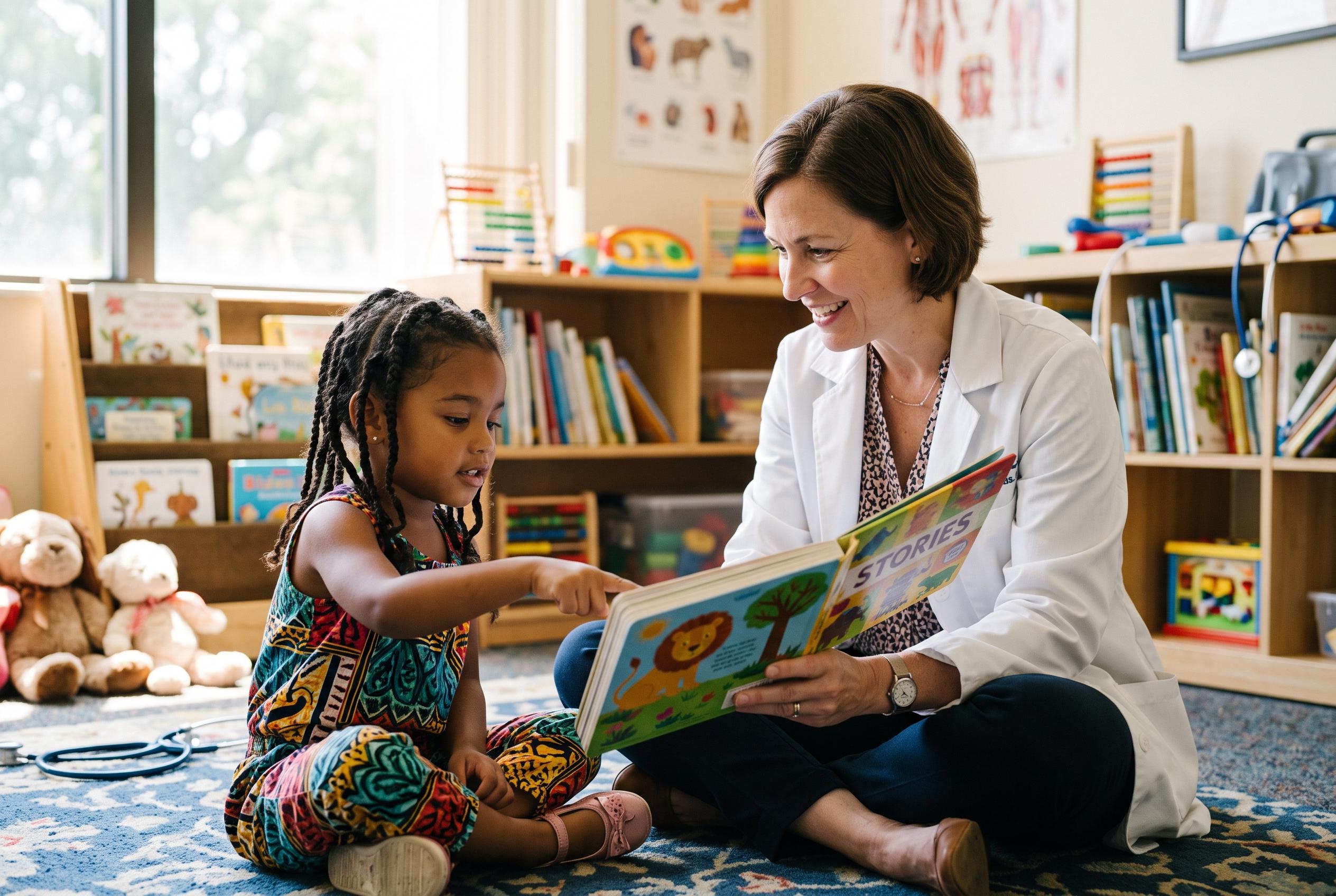
The mechanics are deliberately simple, though accounts of the clinic flow differ. Education Week said families generally do not know in advance that the literacy check will be part of the appointment and that a coordinator comes in after the clinician finishes. In an interview with WOSU, however, Bode said the coordinator enters before the paediatrician. In both versions, the child is taken through a brief, book-based assessment lasting roughly five to 10 minutes. The tool, developed from Dr John Hutton’s “Reading House” work at Cincinnati Children’s, asks children to identify letters, shapes and sounds, spot rhymes and tell stories from the page. WOSU reported that Bode described it as a validated instrument designed for use in paediatric clinics, while AP said it can be given in English or Spanish.
What follows is more intervention than test. Education Week said coordinators, many with early childhood qualifications similar to those of pre-school teachers, spend another five to 10 minutes with caregivers after the screen, talking through activities for home and asking about nursery or pre-school enrolment. AP reported that personalised literacy plans are then drawn up and that families are shown how to practise with their children through read-alouds and similar routines. The take-home kits can include books, dry-erase boards, safety scissors and pencils with rubber grips to build motor control, according to AP, and Nationwide Children’s says the packs were designed with Columbus City Schools kindergarten teachers and literacy specialists so that practice at home matches classroom expectations. Coordinators then keep working the case, linking families to library programmes, pre-school places, Head Start or SPARK home visits and checking back by phone over the following three months.
The target population is not accidental. AP said the hospital chose clinics largely because they sit near schools with weak kindergarten-readiness scores, while Education Week reported that about 75% of families across the participating practices are on Medicaid. Nationwide Children’s says roughly two in three children entering public-school kindergarten in Franklin County are not ready. Early findings suggest the need is substantial: WOSU said Bode estimated about half of screened children need added support, and the hospital’s own May account said internal research found nearly half of preschool-aged children screened were identified as at risk or in need of extra help.
The public record also shows a programme expanding quickly enough to create some confusion about its scale and start date. AP described it in February as a 2022 launch that had carried out more than 2,400 screenings in about half of the hospital’s 13 clinics. WOSU, reporting in March, said Bode put the total at more than 3,000 children across seven clinics. Education Week, also in March, quoted Bode saying the screenings had launched in November 2023 and were operating in seven clinics. That discrepancy may reflect a difference between the broader initiative and the current clinic model, but the hospital has not presented a single, settled public timeline across outlets.
Even so, the experiment is drawing attention because little in US paediatrics looks quite like it. AP noted that literacy screening is not standard medical practice, though centres such as Boston Children’s Hospital promote early-literacy resources to families. Bode told WOSU that no other system was using this assessment in the same way in a busy primary care setting. By summer, the American Hospital Association had turned the programme into a case study for other health systems, with Bode and kindergarten-readiness lead Carneshia Edwards arguing on an AHA podcast that early language and literacy development can shape long-term health and wellbeing. The fact that Fortune picked up the story as a national business and policy piece suggests the idea is already travelling well beyond education reporting.
Nationwide Children’s says it is now tracking longer-term measures, including kindergarten-readiness results and early academic outcomes, rather than relying only on anecdotes from the exam room. The hospital says the early signals are encouraging, but Bode’s own formulation is more cautious: “Now we want to be sure this intervention truly moves the needle on school success.” That is the test that matters. If a doctor’s visit can reliably help children arrive at school ready to read, the model will not stay confined to Columbus for long.
Disclaimer: This content is for informational purposes only and is not intended to be a substitute for professional medical judgment, advice, diagnosis, or treatment.