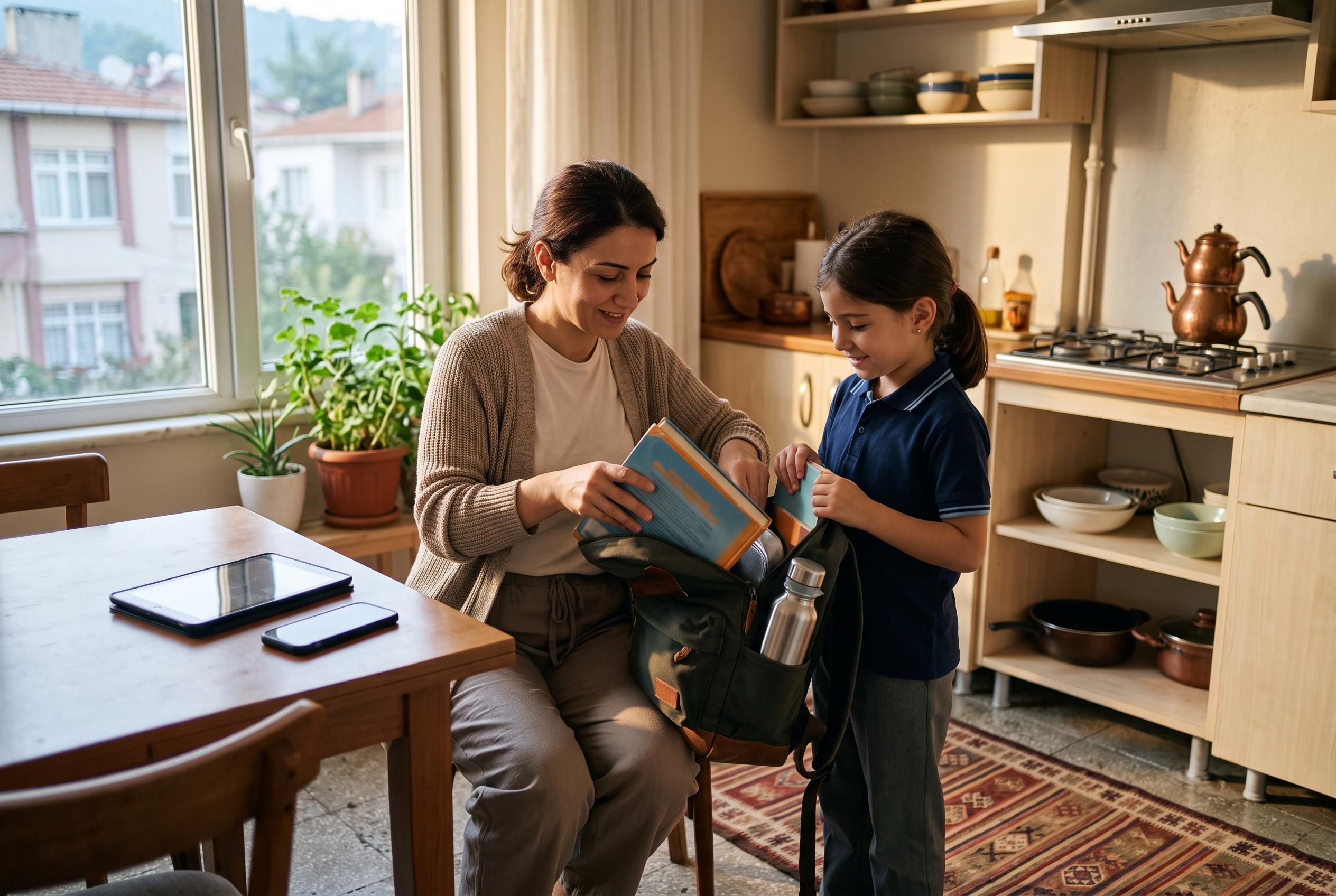

Families in Turkey are being guided to prioritise sleep routines, limit screen time, and foster positive perceptions of school to ensure children adapt more easily at the start of the new academic year.
Families across Turkey are being urged to treat the opening days of the school year as a transition to be managed, not a test to be passed, with health and education officials telling parents to rebuild sleep routines, scale back screen use and present school as a welcoming place before the autumn term formally begins on 14 September. Under the Ministry of National Education’s 2026-27 calendar, adaptation sessions for pre-school children and pupils entering the first year of primary school run from 7 to 11 September, while guidance work is also planned for pupils moving into fifth year, preparatory classes, ninth year and boarding schools.
In a written statement issued from Ankara on Monday, the Health Ministry said children beginning school for the first time adjust more easily when school is described as a pleasant place for learning and socialising. Parents were told to answer questions patiently, explain the daily routine in advance and work closely with teachers and school leaders over timetables and arrangements. The ministry also warned families not to compare a child with classmates or other children around them, saying remarks of that kind can undermine confidence just as pupils are trying to settle.
Doctors say the advice is not simply about easing nerves. Reporting earlier this year, Anadolu Agency cited Doç. Dr. Mehmet Köle saying that sleep disrupted during the holidays can weaken attention, memory, emotional control and the body’s immune defences, all of which matter when children are returning to class. He said families might allow some flexibility in the break, but bedtime should not drift by much more than 60 to 90 minutes. To get children ready for school again, he recommended starting four or five days in advance and moving bedtime and waking time earlier by 15 to 20 minutes at a time. Screen exposure, he added, should end an hour before sleep. Köle said children aged six to 12 need nine to 12 hours of sleep a day, while those aged 13 to 18 need eight to 10.
Another warning from the public health system focused on what happens when that reset does not happen. Prof. Dr. Esra Çöp of Ankara Bilkent City Hospital said children whose screen time rose sharply over the summer can struggle to return to school routines because sleep patterns have slipped and concentration has been eroded. She said the problem extends across televisions, tablets, phones, gaming platforms and computers, and can show up in the classroom as poor motivation, wandering attention and repeated thoughts about what a child was doing on a screen rather than the lesson in front of them. In more serious cases, she said, it can lead to late waking, lateness, absenteeism and even school refusal. Her advice was for parents to reduce screen time gradually instead of trying to impose every rule at once.
The concern is broader than tiredness alone. In a separate Anadolu Agency report last week, İstanbul University lecturer Doç. Dr. Mehmet Gürlek said digital devices were one of the biggest barriers to building the active vocabulary children need for school. A child arriving with a phone, he argued, is more likely to lose focus, less likely to communicate properly with friends and therefore less able to express themselves. Gürlek also linked anonymous behaviour online to peer bullying, warning that children can say things behind a screen that they would never say face to face, then come to see that behaviour as normal. He said families must also look at their own habits, because adults who spend long stretches on their phones while telling children to stop are unlikely to be persuasive role models.
Counsellors working directly with families say anxiety at the start of school can be easy to misread. Yaren Kırat, a psychologist at the Tarsus MERCİ Student Counselling and Guidance Centre in Mersin, said some children adapt from the first day while others may need several weeks. The signs of difficulty can include crying, refusing to separate from a parent, restlessness, stomach ache and refusal to go to school. Kırat said families should prepare for school together with the child, cut back screens and adjust sleep gradually before term begins, while regular communication with teachers can make the process easier. Most importantly, she said, parents in the first weeks should pay more attention to how a child feels about school than to immediate academic performance. MERCİ centres in Tarsus, Yenişehir and Anamur are offering counselling for families during the period, with appointments available through Alo 185 TEKSİN.
The size of the annual reset helps explain why officials are pushing the message so hard. Teacher preparation for the new year began on 1 September, according to the national calendar, and the first term will continue until 22 January 2027 before the school year ends on 25 June 2027. The ministry has also said family participation will be woven more deliberately into transition work through the “Ailemle Okul Yolu Programme”, reflecting a wider view that settling into school affects family communication and social relationships as much as it affects lessons.
Taken together, the message from ministries, doctors and local counsellors is unusually consistent: start changing routines before problems become entrenched, keep devices out of bedrooms, stop screen use well before sleep, talk about school in reassuring terms and do not turn the first days into a comparison with other children. If distress remains intense, or a child keeps refusing school, waking late or arriving unprepared after those changes, specialists say parents should seek professional support rather than assume the difficulty will disappear by itself.
Disclaimer: This content is for informational purposes only and is not intended to be a substitute for professional medical judgment, advice, diagnosis, or treatment.