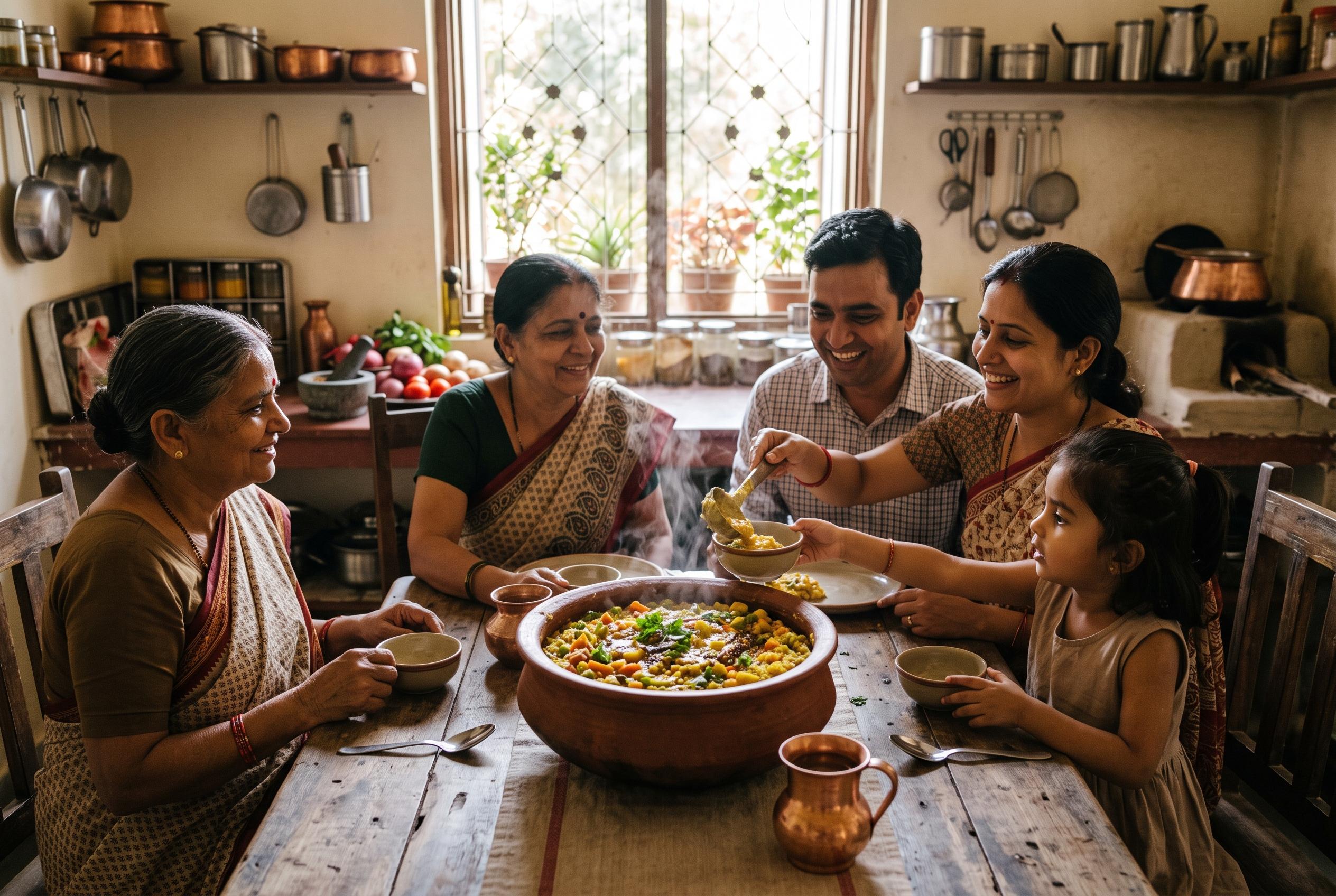

Celebrity chef Sanjeev Kapoor introduces a new version of khichdi aimed at reluctant young eaters, highlighting its evolving role as a comforting, adaptable staple across India’s diverse culinary landscape.
Sanjeev Kapoor’s latest khichdi tip turns a dish many families treat as plain sickroom food into something aimed squarely at reluctant young eaters. Aaj Tak (aajtak.in) reported on Monday, 7 September 2026, that Kapoor’s child-friendly version uses rice with several forms of moong dal, then folds in chopped beans, grated carrot, ginger, cloves, cinnamon, asafoetida, turmeric and ghee before pressure-cooking it for 2-3 whistles and serving it soft, with yoghurt or papad.
That framing is slightly different from the version Kapoor’s own rainy-day writing popularised last year. Hindustan Times (hindustantimes.com), drawing on a 1 August 2025 blog post by Kapoor, presented khichdi as monsoon comfort rather than nursery camouflage, calling it “the food equivalent of a warm hug”. Its ingredient list was also more standard: 1 cup rice, 1 cup split red lentils or a moong-masoor mix, cumin, onion, tomato, ginger, garlic, turmeric and ghee or oil, with the grains soaked for about 30 minutes and cooked for 3-4 whistles. Kapoor’s note there suggested peas or carrots for softness and recommended finishing with ghee, papad or pickle. (hindustantimes.com)
What makes the new recipe notable is not that Kapoor has suddenly discovered khichdi, but that he keeps returning to it as a flexible, emotionally loaded staple. The Indian Express (indianexpress.com) reported during World Food India in November 2017 that khichdi had been chosen as the event’s “brand food of India” while Kapoor served as its brand ambassador. He argued then that the dish crossed region, class and occasion, saying: “Khichdi is consumed across the country. Everybody has their own version of it. Moreover, it is eaten in health and in sickness. It is made when someone is born as well as when someone dies.” Rana Safvi, the historian quoted by the paper, added that “it cannot be attributed to one religious community”. (indianexpress.com)
That same report made clear why khichdi resists being pinned down to a single recipe. According to The Indian Express (indianexpress.com), Gujarat has Ram Khichdi and the gentler Sola Khichdi; Rajasthan may replace rice with millets or whole wheat; Maharashtra has a version with tapioca pearls; and in Uttarakhand it is served as prasad at Badrinath. Safvi said Jahangir was thought to favour a version enriched with pistachios, raisins, spices and ghee, while food historian Pushpesh Pant told the paper that “the most exotic khichdi was perhaps prepared in Wazid Ali Shah’s royal kitchen” with almond slivers and pistachios cut to resemble grains and lentils. Seen against that background, Kapoor’s beans-and-carrot children’s pot looks less like a reinvention than the latest local variation in a very old family.
Kapoor has also long presented khichdi as part of his own everyday routine, not merely a television-friendly recipe. Live Hindustan (livehindustan.com) reported in July 2020 that he dismissed the idea that he ate restaurant-style dishes at home, saying people sometimes sent him gifts such as 3kg of Italian pasta or truffles costing Rs15,000 a kilogram, but that his usual household food was much simpler. “Main kabhi khichdi to kabhi dhokla se kaam chalata hoon kyunki mujhe fit bhi rehna hota hai,” he said, adding that after a high-calorie dish he would either go for a walk or eat something light and easy to digest later. The same interview also cast him as notably undramatic in domestic kitchens: rather than criticising food, he said, he preferred to suggest how it might be improved.
That image of khichdi as plain, reliable food has surfaced in Kapoor’s stories about powerful diners too. In April 2025, The Indian Express (indianexpress.com) reported Kapoor’s recollection of cooking for Prime Minister Narendra Modi in Abu Dhabi during the UAE visit in early 2018, after an invitation from Crown Prince Mohamed bin Zayed. Kapoor said Modi, who maintains a pure vegetarian diet, liked simple staples including khichdi, parathas and thepla. “He isn’t fussy at all. He isn’t like agar ye nahi mila toh mera din nahi hoga… he is very simple and believes in simplicity,” Kapoor said, while also recalling the prime minister’s curiosity about local food such as hummus and ful medames.
Kapoor’s strongest public association with khichdi still comes from spectacle rather than home cooking. NDTV Food (ndtv.com) reported before World Food India opened in November 2017 that more than 50 people had spent over three months planning a record attempt in a specially made three-layer stainless-steel kadhai measuring 7 feet across and holding 1,000 litres. The planned dish was to use not only rice and moong dal but also amaranth, jowar, bajra and barley, and the organisers said it would be shared with dignitaries, sent to foreign missions and distributed to about 60,000 orphan children.
When the cooking was over, the number had grown. The Times of India (recipes.timesofindia.com) said a team of 30 led by Kapoor cooked 918kg of khichdi overnight at the India Gate lawns, enough for Guinness World Records to log it as the largest serving of a beans-and-rice dish. Kapoor said: “I’m satisfied with our efforts and this dish represents the entire country,” later adding that it was made with “a lot of love” and was “a gift of India to the world”. The paper reported that the steam-cooked wok had to be lowered by crane for weighing, with spatulas “almost the size of oars” used to stir it, while Baba Ramdev called khichdi “Indian super food” and officials said much of it would go to NGOs and foreign missions. (recipes.timesofindia.com)
Disclaimer: This content is for informational purposes only and is not intended to be a substitute for professional medical judgment, advice, diagnosis, or treatment.