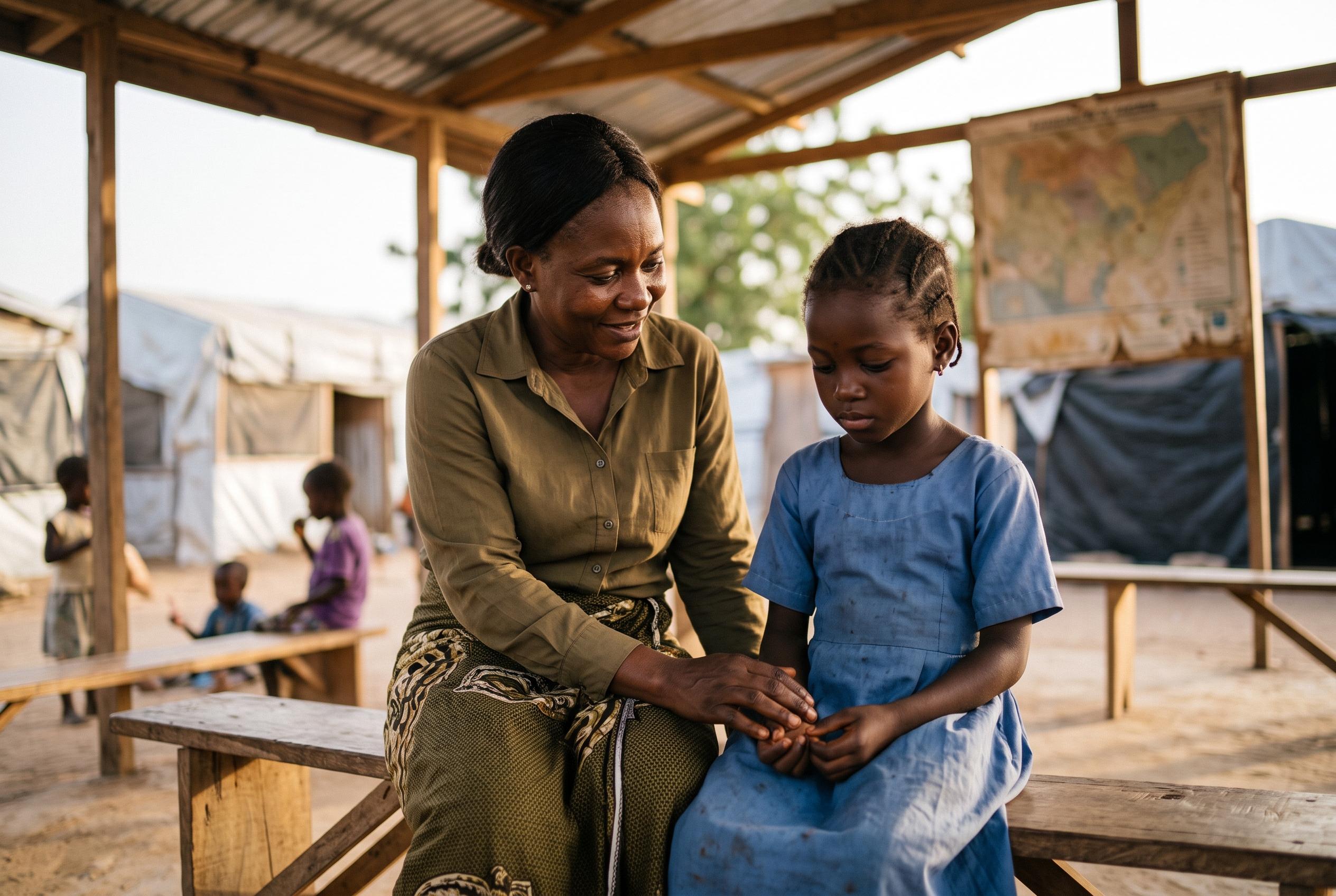

Nigerian officials and aid agencies warn that untreated trauma among displaced children from Boko Haram conflict has become an urgent priority, emphasising the need for integrated psychosocial care alongside ongoing military and reconstruction efforts.
At a policy dialogue in Maiduguri on Wednesday, 2 September, Nigerian officials and aid agencies warned that trauma among children uprooted by the Boko Haram conflict can no longer be treated as a secondary humanitarian concern. Figures presented by Bernard Doro, the minister of humanitarian affairs and poverty reduction, put the scale of the crisis starkly: 79.7 per cent of displaced children were said to be living with post-traumatic stress disorder, 84.8 per cent with depression and 90.7 per cent with impairments severe enough to affect learning, sleep and social development. Another local account of the briefing said the damage was being compounded by the instability of camp life and repeated displacement, reinforcing the government’s argument that relief for families must include rehabilitation as well as food, shelter and schooling.
Even the format of the gathering underlined how fast-moving the initiative remains. Daily Trust, in a report republished by AllAfrica, described the Maiduguri session as a one-day national dialogue supported by the North-East Development Commission. The Guardian, by contrast, said it formed part of a three-day national policy dialogue jointly organised by the president’s health office, the humanitarian affairs ministry, the commission and the office of the National Security Adviser. What did not differ between the accounts was the cast in the room: officials, academics, security personnel, aid groups and development partners brought together to consider what years of war have done to children in the North-East.
Salma Ibrahim Anas, a presidential health adviser, anchored the discussion in one family’s ordeal. Recalling a woman who fled Bama with seven children during the insurgency, she said the mother reached Dalori camp with only one child. “By the time she finally reached the relative safety of the Dalori IDP camp, she had only one child left–with no knowledge of whether the other six were still alive or dead,” Anas said. For her, the episode illustrated more than loss in the moment: trauma left untreated, she argued, can shape children’s behaviour, relationships and ability to contribute to society, and may even be passed on across generations.
Yusuf Tanko Sununu, the former minister of state for education, pushed that warning further. According to Daily Trust’s reporting, he told the dialogue that children who have seen killings and family destruction can grow up with a desire for revenge if nobody intervenes. He cited an orphaned child who, after watching his parents being killed, vowed to take up arms in retaliation. Sununu called for ring-fenced budget provisions, special funds and stronger legal frameworks for children caught up in conflict. Doro framed the same threat in national terms, saying Nigeria could not afford to lose a whole generation to the “silent wounds of war”.
Borno’s government used the occasion to argue that psychosocial care belongs alongside military action and reconstruction, not somewhere after them. Governor Babagana Zulum, represented by deputy governor Umar Usman Kadafur, said mental-health support had become a central part of the state’s humanitarian response. The Guardian reported that he welcomed the Maiduguri talks as long-overdue recognition that the “invisible wounds of war” demand the same urgency as the visible destruction, particularly in a state widely seen as the epicentre of the insurgency.
The wider humanitarian backdrop helps explain that sense of alarm. Doro told The Guardian that the 17-year Boko Haram conflict has displaced more than 1 million children in the North-East alone. United Nations planning documents show a broader emergency still grinding on behind those headline figures. Under the 2025 Humanitarian Needs and Response Plan for Borno, Adamawa and Yobe, 7.8 million people were assessed as needing assistance, while just over US$910 million was sought to reach 3.6 million of them. OCHA said those needs were being driven not only by conflict, but by climate shocks, economic instability, flooding, disease outbreaks, food insecurity and malnutrition.
For children, the fallout is visible in education as well as mental health. UNICEF said nearly 2 million people were internally displaced across Borno, Adamawa and Yobe by mid-2025, while conditions had deteriorated sharply because of worsening food insecurity, fresh violence and early flooding. In camps across the three states, 69 per cent of school-aged children still lacked access to education. The agency said emergency support was needed for 875,814 children in Borno, 444,298 in Adamawa and 328,690 in Yobe, even though 309,929 children had been reached with education services across 38 local government areas by June that year.
Protection services have expanded, but the mismatch between need and capacity remains severe. UNICEF said 385,067 people in the three north-eastern states received critical child-protection services in the first half of 2025, including psychosocial support, family tracing and reintegration work. It also reported that 51,089 children formerly associated with armed groups benefited from reintegration services, while 170 unaccompanied or separated children were reunited with their families. Yet the same report said around 1 million children in the region were at risk of severe acute malnutrition in 2025, and local reporting on this week’s dialogue suggested that the psychological toll is being sharpened by the precarious conditions in camps and temporary settlements.
Officials are now trying to connect this week’s trauma debate to the longer recovery of the region. During a separate visit to Borno in February, Doro joined Mohamed Malick Fall, the UN resident and humanitarian coordinator, and ambassadors from India, Egypt, Indonesia, the Philippines, Turkey, Malaysia and Qatar on an assessment of conditions in the state. BusinessDay reported that Doro praised Borno’s vocational training centres and schools, arguing that “if you want to change the game, you have to touch the root cause of the crises”, starting with education. That thinking ran through the Maiduguri dialogue as well: if Nigeria wants conflict-affected children to return to classrooms, livelihoods and community life, mental-health care will have to move from the margins of emergency aid to the centre of public policy.
Disclaimer: This content is for informational purposes only and is not intended to be a substitute for professional medical judgment, advice, diagnosis, or treatment.