
Queensland has transitioned its statewide school-entry vision screening scheme from a pilot to a permanent service, screening over 400,000 children since 2016 and refining methods to better identify visual problems early in childhood.
Queensland’s school-entry eye screening scheme has shifted from a pilot-style rollout to an entrenched statewide service, with Children’s Health Queensland saying it has now checked the eyesight of 400,496 Prep pupils since 2016 and referred more than 30,000 for follow-up care. The programme, offered free to schools across the state, has grown into one of the few services in Australia attempting universal vision screening at the start of formal schooling.
That scale matters because the service was set up to close what Clinical Excellence Queensland has described as a longstanding gap in early childhood screening. Before 2016, the state had no single, equitable model covering metropolitan, regional, rural and remote communities. The service was later written into Queensland’s Public Health Act in 2023 as a school health service, a change officials say has made it easier to share information with schools, secure consent and support families through follow-up.
The operating model is broader than a simple school visit. Clinical Excellence Queensland says the programme runs through a hub-and-spoke structure, with Children’s Health Queensland overseeing governance, protocols, training and statewide data while nurses based in local Hospital and Health Services carry out the screenings. The service now reaches more than 1,500 schools a year and is delivered by 44 registered nurses. Queensland’s health service directory lists it as a government service for Prep children with no referral, no appointment and no charge.
The headline numbers point to a large public-health footprint, but the underlying research gives a more detailed picture of how the programme performs. A retrospective review of records from January 2017 to December 2020 found that 185,685 children were eligible, 176,164 consented and 164,890 were actually screened. Of those screened, 12,148 children, or 7.4 per cent, were referred to an optometrist or ophthalmologist. Children’s Health Queensland now says 80 per cent of referred children were confirmed to have a visual abnormality after assessment, but peer-reviewed studies covering the earlier years reported lower confirmation rates depending on how outcomes were counted.
Those studies also show what the service is finding. In the 2025 paper led by Ye Li, researchers reported that among the children screened in 2017 to 2020, refractive error was the most common confirmed problem at 2.33 per cent of the screened group, followed by unspecific abnormalities at 0.82 per cent and anisometropia, where the eyes have unequal focusing power, at 0.72 per cent. The paper also identified 755 cases of anisometropic amblyopia and 136 of strabismic amblyopia. The authors found no significant difference in age at screening between children with and without abnormal findings, but some conditions were more common in girls while anisometropic amblyopia was more common in boys.
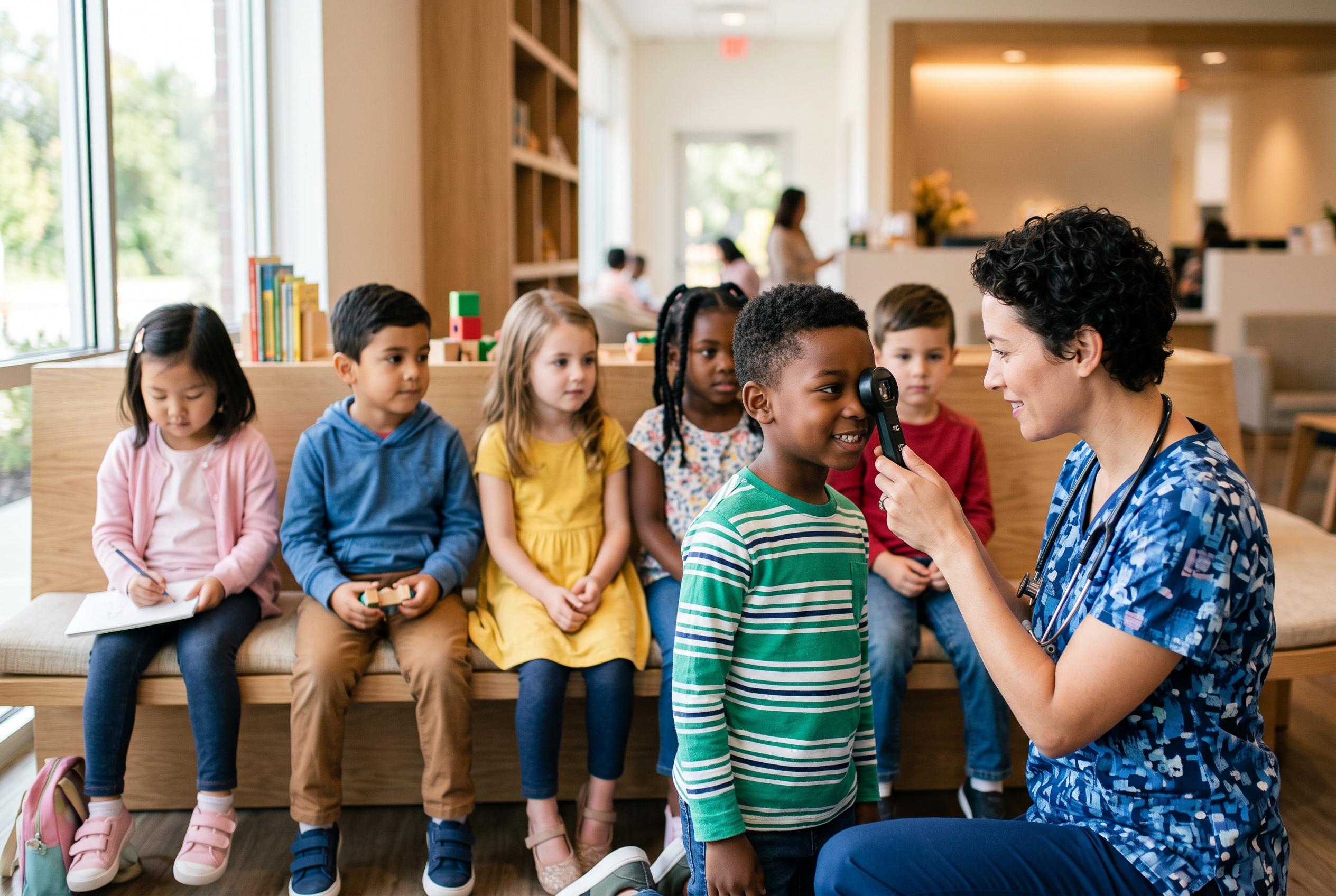
The design of the screening itself has been a selling point for programme leaders. The current service uses two non-invasive tests and takes about five minutes: a photograph-based screen of the eyes and a card-matching visual acuity task. Earlier research assessed the pair of tools in more detail, using the Parr 4 chart and a Welch Allyn SPOT photoscreener. That study found the strongest accuracy when both tests pointed to a referral, with a positive predictive value of 0.91, compared with 0.73 for photoscreener-only referrals and 0.76 for visual-acuity-only referrals. Rachel Keel, the programme’s nurse unit manager, said: “Early detection of a vision problem can change a child’s life.”
The scheme started far more modestly. When the Queensland government announced it in 2016, the plan was for a four-year rollout under a A$14 million programme, with more than 30 nurses to be appointed by February 2017 and roughly 65,000 preparatory students in the target group each year. Cameron Dick, then the health minister, launched the project at Berrinba East State School near Brisbane on 31 August 2016. At that point about 3,350 preparatory pupils in Brisbane had already been screened, and the central hub was being built around eight registered nurses and three clinical nurses.
Not everyone was convinced at the outset. Optometry Queensland Northern Territory said at the time that it had reservations about a nurse-led system that relied in part on photo-screening devices, warning that similar instruments used in US paediatric studies could miss “one in four children with significant refractive error or strabismus”. It also questioned training arrangements and the referral pathway. Later programme documents suggest those concerns helped shape further refinement. Clinical Excellence Queensland says a statewide data system called QVision was introduced in 2019, an online outcomes portal followed in 2021, and a Gaze Rescreen Trial began in 2025 to reduce false-positive referrals and the anxiety and inconvenience they can create for families.
The service is also being used as a base for expansion. Clinical Excellence Queensland says ethics approval was obtained in 2025 for a Year 6 pilot focused on myopia, reflecting concern about rising short-sightedness in older children. For now, though, the Prep programme remains the centrepiece: a legislated, no-cost school health service that Queensland says has moved well beyond an experiment and into the fabric of early years care.
Disclaimer: This content is for informational purposes only and is not intended to be a substitute for professional medical judgment, advice, diagnosis, or treatment.