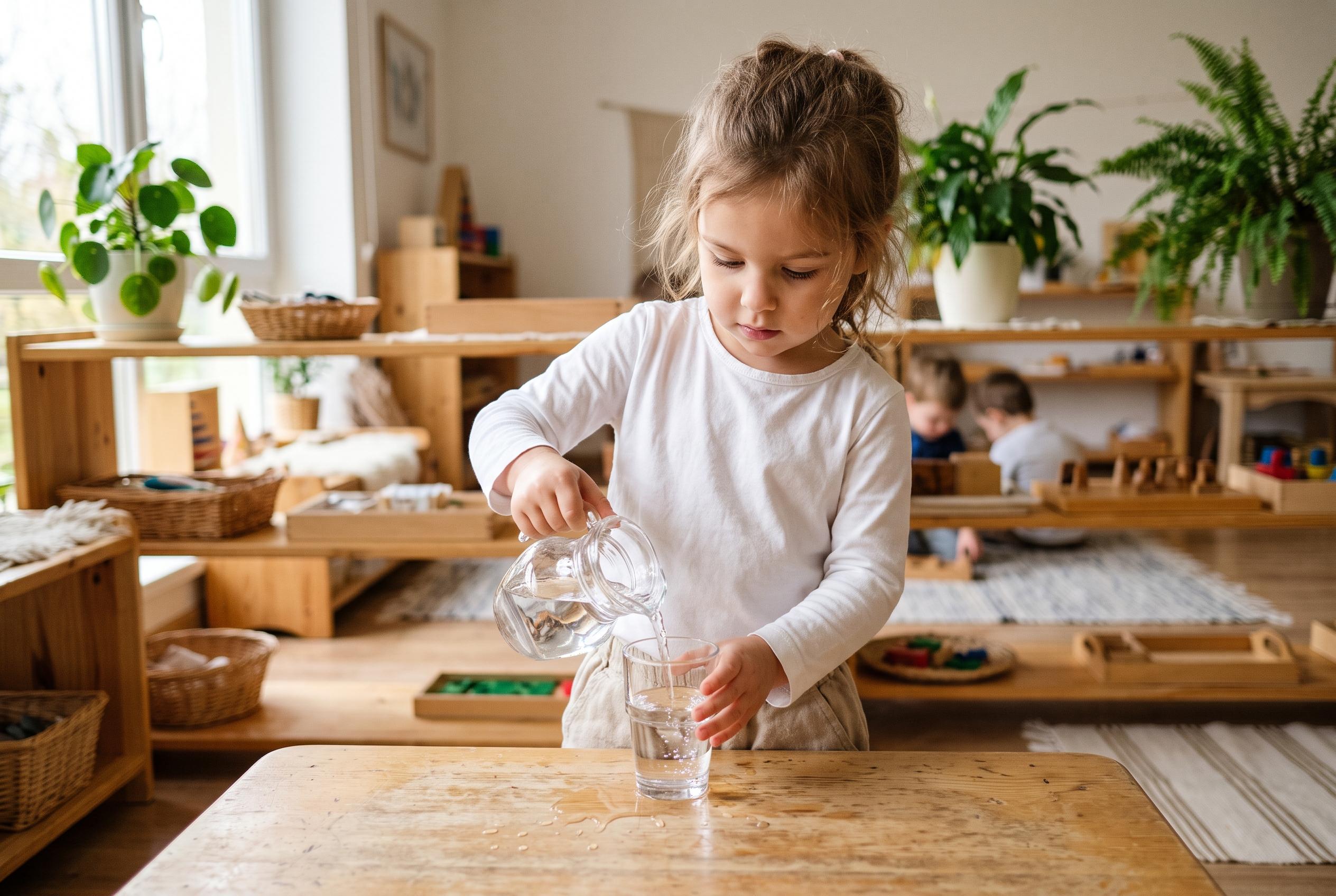

Simple pouring activities in Montessori education are carefully structured lessons that foster independence, fine motor skills, and foundational mathematical thinking, illustrating their vital role in early childhood development.
What can look to an adult like a child merely moving water from one small vessel to another is, in Montessori practice, a carefully designed lesson in movement, judgement and self-reliance. Home guides say the work can begin from about 12 months with a child-sized jug and cup, while classroom materials for ages three to six build the same skill into more formal exercises such as wet pouring and funnel work. School tutorials describe the activity not as a diversion but as one of the early routes into independence and readiness for later academic learning. (dailymontessori.com)
The exercise is also part of a deliberate sequence. The North American Montessori Center says children are usually given solids before liquids because water creates a higher chance of error and is harder to manage. The progression it outlines starts with transferring water between bowls with a sponge, then moves to pitcher-to-pitcher pouring, then to filling one glass and, later, three glasses. That sequence is meant to isolate difficulty step by step: first broad arm and hand movement, then finer control, then judgement about dividing equal amounts. NAMC argues that this estimation work helps form a “mathematical mind”, while the shift from whole-hand movement towards a pincer grip is indirect preparation for holding a pencil and writing. (montessoritraining.net)
Much of the teaching sits in what happens when the child does not get it exactly right. The Global Montessori Network’s funnel lesson includes a sponge on the tray and even a marked line on the narrow-necked bottle as a built-in “control of error”. Daily Montessori likewise advises adults to keep a cloth nearby and treat spills matter-of-factly so the child can wipe them up alone. A 2026 Montessori parenting guide makes the same point more bluntly, saying spills “are learning opportunities, not mistakes”. Cynthia Brunold-Conesa, writing for the American Montessori Society, ties that approach to Montessori’s wider idea of responsibility, quoting her line that the child “is thus freed from the greatest of all dangers, that of making an adult responsible for his actions”. (theglobalmontessorinetwork.org)
There is, however, an active discussion inside Montessori circles about whether classroom pouring trays are at their best when they lead directly to real life. Brunold-Conesa, drawing on Angeline Lillard’s work, writes that “Real, true purpose is a hallmark of Practical Life” and asks whether children throw themselves more fully into work that genuinely helps the household or classroom than into teacher-made exercises with no wider use. Lillard’s comparison is pointed: grating soap for practice may not carry the same meaning as grating cheese for a pizza the child will actually eat. Even so, the American Montessori Society article concludes that both authentic and modified exercises can still promote order, concentration, coordination, independence and cooperation. (amshq.org)
For parents, the practical advice is strikingly unflashy. Daily Montessori recommends starting with a very small amount of water, using child-sized glassware and placing the work on a tray. The adult sits beside the child, demonstrates slowly, lifts the jug with two hands for stability and gently taps the spout against the rim before pouring to reduce drips. The pour should stop before the cup is full. None of this requires specialist equipment; what matters is that the task is real, slow enough to observe and manageable enough for the child to repeat. (dailymontessori.com)
As children become steadier, the work becomes more exacting. In the funnel lesson published by the Global Montessori Network, the child holds the bottle steady, positions the funnel, pours carefully, waits “for the last drop” and then wipes the tray if needed. The stated aims go beyond avoiding mess: the lesson is intended to build patience, attention, finger strength, pincer grip and problem-solving, while also helping children do everyday tasks such as pouring milk into small containers independently. Waterfront Academy suggests beginning with clear water so children can watch the movement, and adding a drop of food colouring if an adult wants to sharpen interest without changing the task itself. (theglobalmontessorinetwork.org)
Home-based Montessori guides now extend the same logic into a longer run of variations. Montessori Mom proposes dry pouring before wet pouring, then pouring into two or three containers to introduce division and estimation, followed by glasses, funnels, ladles or a turkey baster, and eventually using a larger pitcher with a smaller vessel. The same guide argues that each new stage should be introduced only when the previous one can be completed with “relative ease” and the child still wants more, adding that repeating the same exercise twenty times can be exactly the deep work adults are tempted to interrupt. From there, the skill is meant to spill into family life: pouring water at meals, watering plants, tipping batter into muffin tins, measuring exactly one cup or filling a bird feeder. (montessorimom.com)
Seen that way, Montessori’s pouring work is less about producing neat little helpers than about building what Brunold-Conesa calls “physical autonomy”. It asks adults to trust children with real materials, real consequences and enough time to master a sequence for themselves. Waterfront Academy’s summary is unusually direct on the point: what looks like “just pouring water” is preparation for literacy, practical life skills and lifelong learning. The task may be humble, but its ambition is not. (amshq.org)
Disclaimer: This content is for informational purposes only and is not intended to be a substitute for professional medical judgment, advice, diagnosis, or treatment.