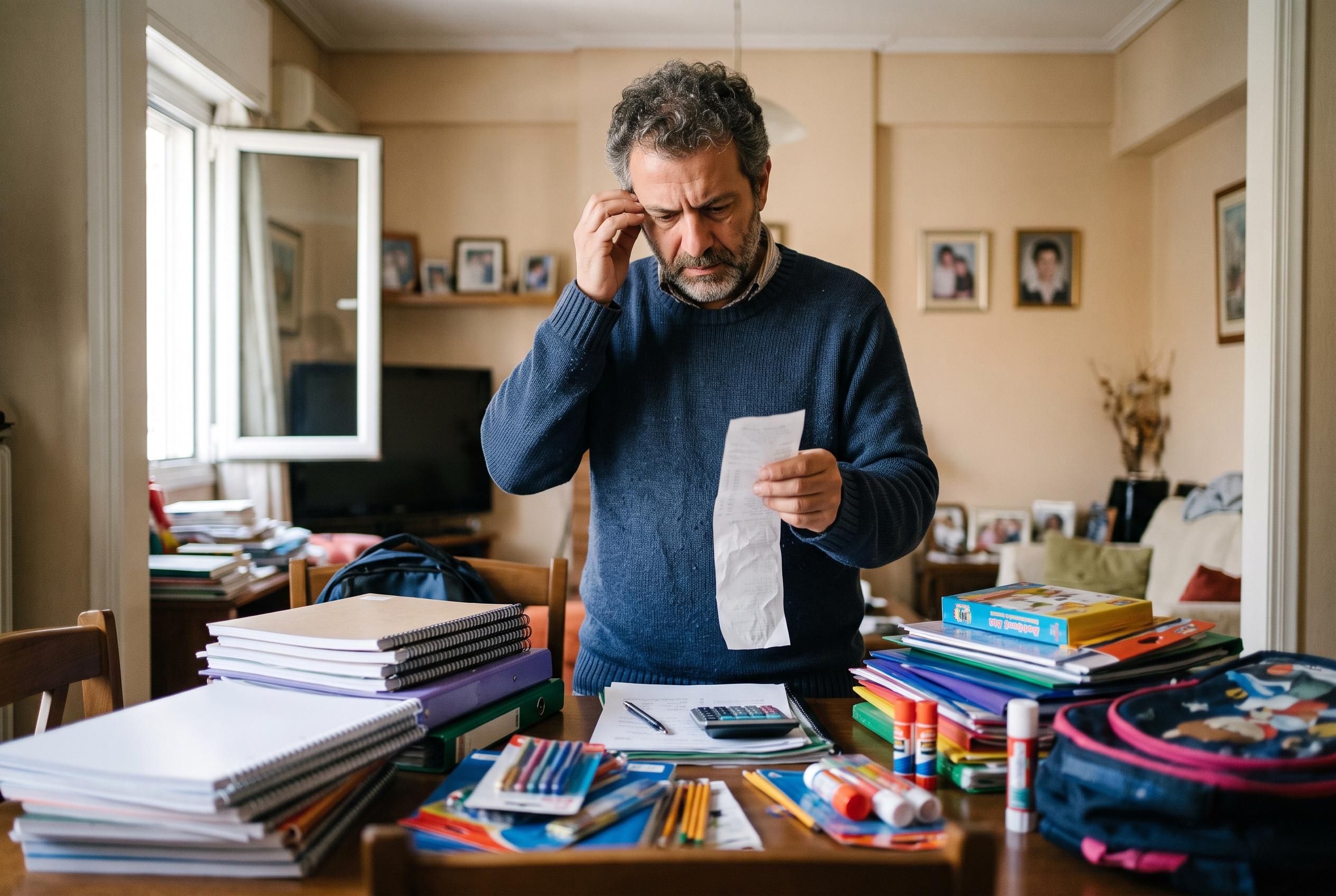

As Greek families prepare for the new school year, the cumulative expenses for children’s supplies, activities, and fees are escalating sharply, prompting concern over the financial burden and the shift towards a costly busy childhood.
In the days before Greek pupils return to class, the most striking number is no longer the price of a notebook but the size of the yearly bill. Radar reported that, once tutoring, language classes, sport, transport, books and exam fees are counted, a family can spend more than €1,200 a year on a child in primary school, while the cost for a pupil in the final secondary years, especially during preparation for the Panhellenic exams, can approach or exceed €5,000. Even the first trip to the shops can run from about €100 to €220 before the term has properly begun. (radar.gr)
That starts with a basket that looks manageable until it is broken down line by line. ERT News and Euronews, both citing a market survey by Ertnews Radio 105.8, put the 2026 cost of basic supplies for a child in the first years of primary school at roughly €100 to €120. Crucially, that figure excludes the school bag, lunch bag or lunch box, food container and water bottle. Euronews said traffic in bookshops and school-supply shops was already picking up in late August, with notebook prices starting at €0.49, maths books at €1.59 to €2.50, two-subject spiral books at €1 to €8, and watercolour pads anywhere from €2.25 to €15. (euronews.com)
Iefimerida’s practical checklist shows why the total rises so quickly. The “basic basket” it described includes a bag, pencil case, notebooks, pencils, pens, erasers, sharpeners, markers, drawing pads, glue, folders, geometry tools, a water bottle and a lunch bag. Its estimate suggests that a parent buying only the essentials will still spend around €100 to €120 per child, while adding a mid-range bag can lift the cost to about €130 to €165 before food containers are counted. For a household with two children, that becomes €260 to €330; for three children, it can approach or pass €400 to €500. (iefimerida.gr)
The larger burden, though, sits outside the stationery aisle. To Vima reported that essentials for primary pupils can range from €80-€90 to as much as €300 depending on brand, with lunch kits and water bottles adding €30-€50. Language lessons were put at about €50 a month plus textbooks, and sports programmes at another €30-€35 a month. CNN Greece added clothing and footwear to the September bill, estimating about €100 to €150 for a new pair of trainers, tracksuit, jacket and basic outfit, plus €30 to €100 for specialist kit if a child plays football or swims. By secondary school, To Vima said purchases can reach €200-€350, while families with children nearing university entrance exams may face €294-€400 a month for tutoring, around €600 for summer courses and another €200 a month for subjects such as music, design or extra languages. (tovima.com)
The debate this year is therefore not only about inflation, but about what Greek families are being asked to buy into. A commentary published by Naftemporiki argued that many children are being moved from one organised activity to another – English, a second language, sport, music, chess or robotics – with parents turned into chauffeurs and too little time left for rest, schoolwork or free play. That is an argument, not a statistical study, but the spending reported elsewhere helps explain why it resonates: the same family budget that pays for notebooks is also paying for a timetable that can stretch deep into the week. (naftemporiki.gr)
Consumer groups and retailers are also drawing attention to a subtler problem: stable shelf prices do not always mean stable value. Euronews noted that the lowest prices for many basics appear close to 2025 levels, and recalled that Greece’s Ministry of Development said on 28 August 2025 that companies had pledged to keep school-supply prices at 2024 levels. CNN Greece, however, cited data from the Institute of Retail Consumer Goods Research showing a small average fall of 0.70% in the school-supplies category, while also quoting INKA president Giorgos Lechouritis warning about smaller quantities sold at the same ticket price. Speaking to CNN Greece, he said: “Ένα τετράδιο που πέρυσι είχε 150 φύλλα και κόστιζε 1,5 ευρώ, φέτος εμφανίζεται με 80 φύλλα και πάλι στην ίδια τιμή”. (euronews.com)
Parents are responding in predictable ways: hunting for supermarket offers, comparing bookshops with online retailers, reusing last year’s bags and pencil cases, and sending half-filled notebooks back into service. To Vima said many families are already doing exactly that, while Iefimerida noted how much difference it can make when older items are recycled. Yet the savings have limits. Euronews stressed that the gap between budget and premium products remains wide, and Radar said some teachers hand out their own lists only after the school year begins, which means the spending often continues after the first bell rather than ending with it. (euronews.com)
What emerges from all seven reports is a picture of school as a parallel household economy. The obvious costs are bags, notebooks and felt-tip pens; the less visible ones are language fees, sports subscriptions, tutoring and the constant pressure to add one more useful activity. Greece’s back-to-school season has always been expensive, but this year’s reporting suggests a sharper question underneath the receipts: whether families are merely equipping children for the classroom, or financing an arms race of lessons and programmes that risks crowding out the easier parts of childhood. (radar.gr)
Disclaimer: This content is for informational purposes only and is not intended to be a substitute for professional medical judgment, advice, diagnosis, or treatment.