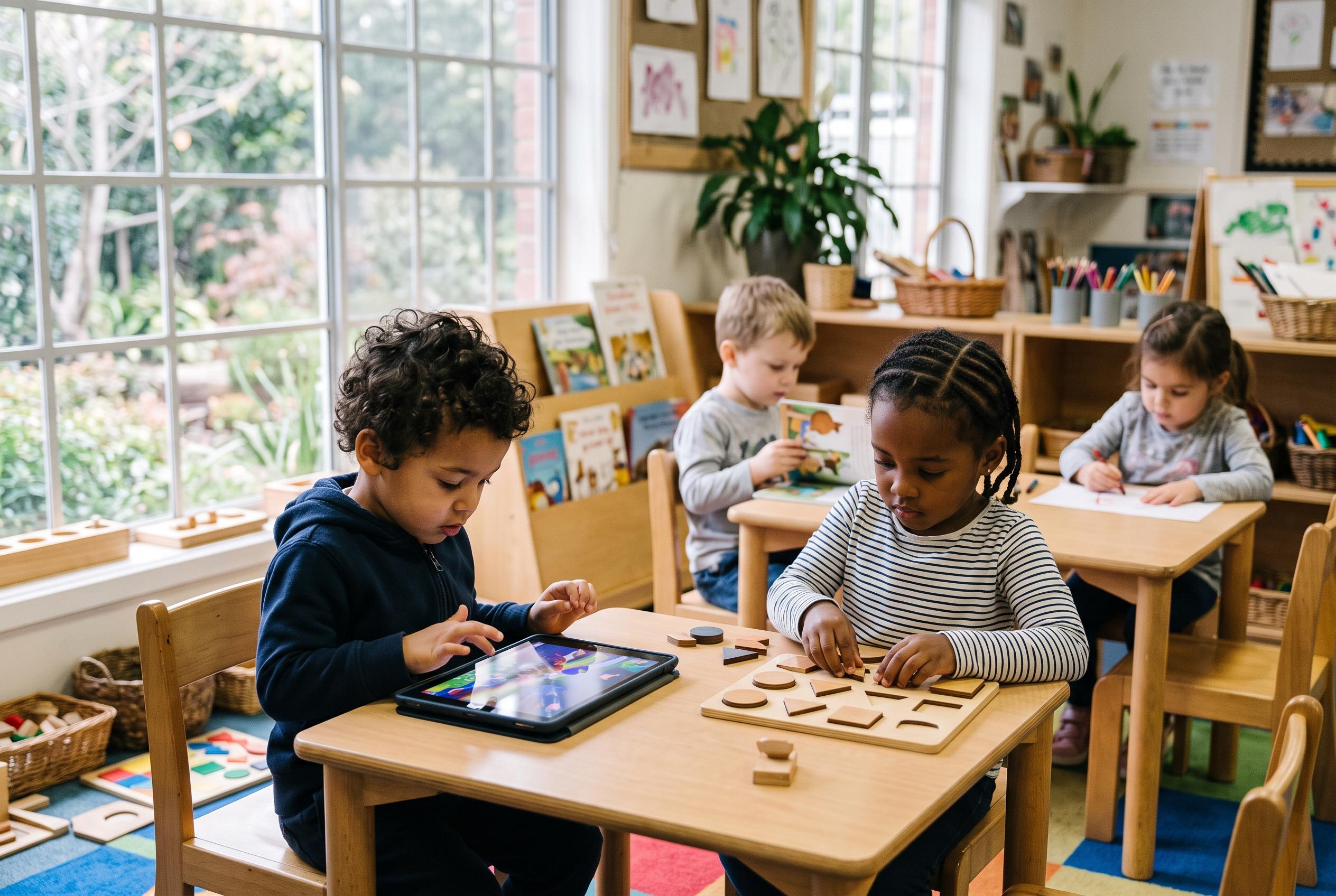

A recent Italian study reveals that half an hour of lively play, whether with Nintendo’s Mario Kart 8 Deluxe or Tangram puzzles, can boost rapid responses yet reduce children’s ability to filter distractions immediately afterwards, prompting a rethink on digital activities in early learning settings.
Half an hour of lively play may leave preschool children quicker off the mark yet less able to shut out distractions, according to an Italian study that found broadly the same immediate pattern after a session with Mario Kart 8 Deluxe as after time spent on a Tangram puzzle. The peer-reviewed paper appeared in August in Computers in Human Behavior Reports as article 101183, suggesting that the short-term shift was linked more to engagement than to screens alone. (sciencedirect.com)
EurekAlert described the research as an experimental study in people, and Phys.org reported that it involved 48 typically developing children with an average age of 5.4. Using a single-blind randomised crossover design, the researchers had each child rotate through three settings: no play at all, 30 minutes with Nintendo’s kart racer, and 30 minutes with Tangram. After each session, the children were tested on attention, speech-sound processing, visual perception and motor coordination. (sciencedirect.com)
What the journal abstract adds to the publicity material is where the gains and losses appeared to sit. Across auditory-phonological, visuospatial and sensorimotor tasks, the children did better when success depended mainly on fast, stimulus-driven processing, including phonemic awareness and spotting visual targets when no distractors were present. But performance weakened as the tasks demanded more control: the abstract points to poorer efficiency under heavy interference, slight dips in phonological short-term memory and less steady sensorimotor aiming immediately after play. (sciencedirect.com)
That trade-off gives the findings a practical edge for nurseries and reception classrooms. AlphaGalileo’s account of the paper said the spell just after intense play may be a poor moment for activities that depend on concentration, inhibition and resisting irrelevant stimuli, but potentially a better fit for exercises built around quick reactions and exploration. In the authors’ words, “Understanding this short-term multisensory and sensorimotor modulation is essential for guiding the integration of digital play into early childhood learning environments.” (alphagalileo.org)
The researchers’ broader argument is that the medium may matter less than the level of activation it produces. On the Bial Foundation’s Science Stories archive, which listed the item on 3 September, the study was boiled down to a temporary shift towards more automatic attentional processes and away from regulatory control in preschool children. That reading is consistent with the paper’s central claim that digital and non-digital play generated comparable short-term effects, rather than there being something uniquely harmful or uniquely helpful about the console game itself. (beyondthebrain.bialfoundation.com)
The route by which the study reached the public also shows how quickly it travelled beyond the journal. BrightSurf and EurekAlert metadata give 3 August 2026 as the article publication date, while the Bial Foundation posted a fuller explainer on 27 July and then carried the item in its science archive on 3 September. Phys.org ran a syndicated version on 4 September, and by Sunday 6 September Financial Gazette was still republishing that copy, extending the paper’s reach without adding fresh reporting. (brightsurf.com)
AlphaGalileo’s bibliographic listing gives the full author line as Giovanna Puccio, Sandro Franceschini, Simona Carbone, Chiara Filotto, Simone Gori, Telmo Pievani, Viviana Trezza, Sara Mascheretti, Andrea Facoetti and Sara Bertoni. EurekAlert said the work formed part of project 153/24, “Psychophysiological activation and learning (to Learn): Evidence from action-like video games to mindfulness”, backed by the Bial Foundation, while its release also listed Italian health and university funding streams among the supporters. What the study does not claim, at least on the published evidence now available, is any lasting cognitive harm or benefit: it measures the immediate aftermath of play, not what remains hours, days or months later. (alphagalileo.org)
Disclaimer: This content is for informational purposes only and is not intended to be a substitute for professional medical judgment, advice, diagnosis, or treatment.