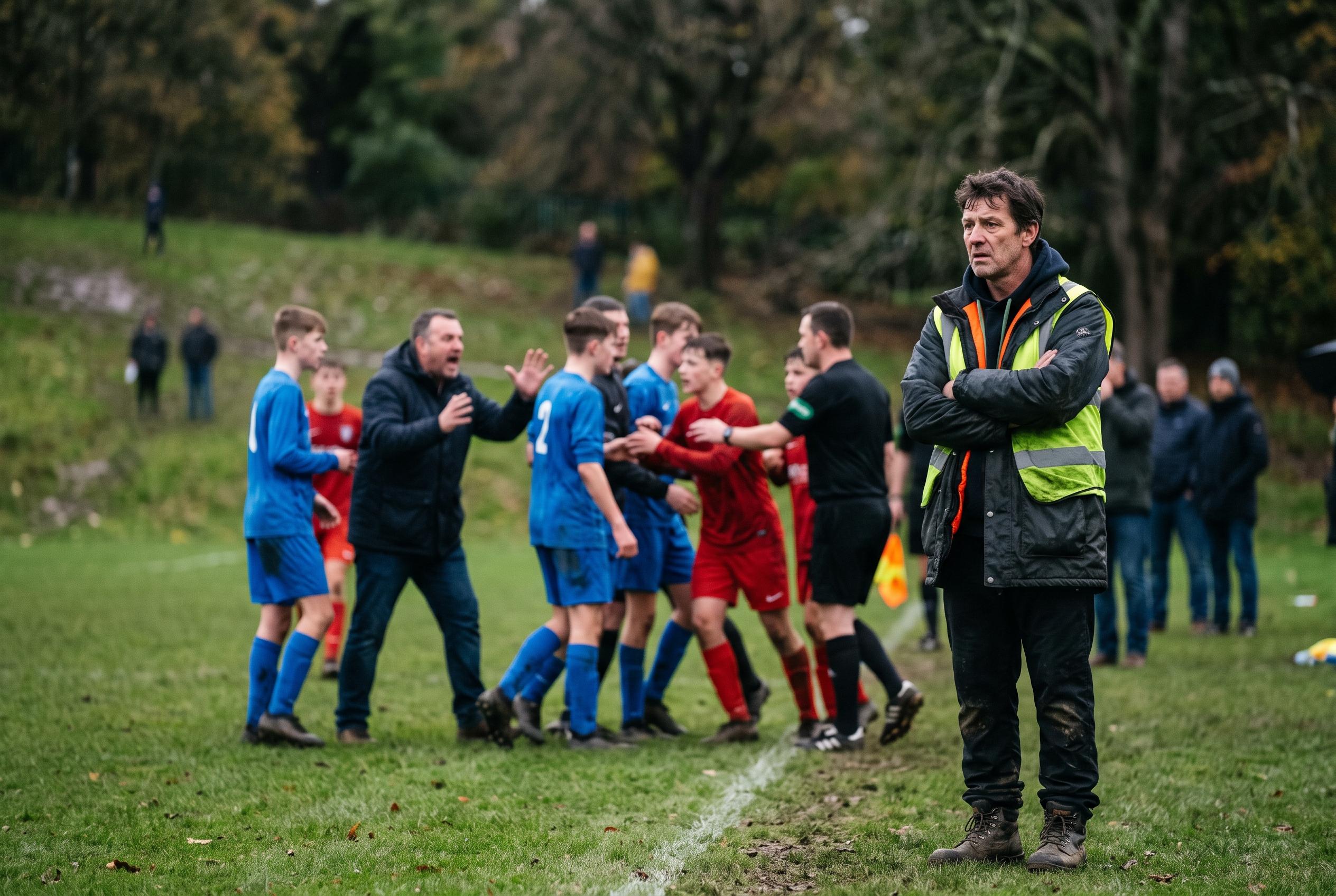

A surge of misconduct and violence at Scotland’s youngest football matches has prompted calls for tougher enforcement and governance reforms, exposing a disconnect between policy ambitions and sideline realities.
Around 750 young children were left without matches in central Scotland after youth football officials suspended the region’s Fun 4s programme and opened disciplinary cases into a week that brought 72 red cards, abandoned fixtures, allegations of discriminatory abuse and a headbutt on the touchline. What might once have been treated as a local embarrassment has instead become a wider test of whether Scottish football can protect children from the behaviour of the adults around them.
In an email seen by BBC Scotland, Central Scotland Football Association secretary Paul Crosbie told team managers: “The line has well and truly been crossed.” He said the new season was only a week old and had already produced a “long list” of incidents with no place in grassroots football. BBC Scotland’s reporting said team officials were alleged to have gone looking for fights, young players had been threatened and a parent had approached a league official aggressively after being asked to move from an area reserved for players and staff. Separate coverage said one of the most serious incidents took place at Broadwood Stadium in Cumbernauld, where police were investigating an allegation of hateful language directed at a child and where some immediate suspensions were issued, including in cases involving adults without the required PVG clearance.
The setting makes the disorder more jarring. According to The National, citing Scottish Youth Football Association chairman Scott Robertson, Fun 4s is meant to be a stripped-back, non-competitive format: four-a-side, mini-goals, no official score, no winners and no trophies. BBC Scotland and other reports described the suspended section as for five- and six-year-olds, while Robertson put the format at six and seven, but either way the children involved were at the youngest end of organised football. Robertson said parents were right to be angry that so many children missed out, yet he also defended decisive action, arguing that volunteers running festivals are often left isolated when tempers flare.
Some clubs have already concluded that formal discipline for children is not enough if the worst conduct is coming from the touchline. The National reported that Hutchison Vale in Edinburgh uses a conduct policy for parents and associated adults based on green, yellow and red cards, with suspensions from attending matches and, in extreme cases, children asked to move elsewhere. Robertson’s argument is that the game has spent too long pretending this is exceptional. He and other grassroots figures told the paper that abuse, intimidation, racism, misogyny, sectarianism and violence are becoming harder to dismiss as one-offs when they recur across age groups and regions.
The evidence assembled beyond the central Scotland cases points in the same direction. The National cited FORZA’s Grassroots Football Report 2026, a UK-wide survey of players, coaches and secretaries, which found that 90 per cent of respondents had witnessed abuse of a referee, 68 per cent blamed parents and spectators, 21 per cent of clubs had cancelled matches because of a shortage of officials and 79 per cent believed volunteer recruitment had become much harder. Tam Smith of Hutchison Vale said many adults now behave as though every primary-school fixture is an audition for the professional game, despite the tiny odds of a child making a career in football. An under-15 coach in the Aberdeen area went further, saying even ostensibly respectable adults can act like “total thugs” once results and status become wrapped up in their children.
The governing body’s preferred answer has so far been education, guidance and changes to matchday set-up. The Scottish FA’s Let Them Play and Let Them Ref campaigns tell clubs to create designated technical areas for team staff only, keep spectators at least two metres back from the touchline and limit on-pitch dialogue at key moments to captains. The governing body has also promoted sideline guidelines, an updated matchday checklist, a grassroots WhatsApp channel and an online Touchline Behaviour Module. It says those measures sit inside a refreshed Player Journey designed to put fun, learning and long-term participation ahead of early results.
There is no shortage of public policy saying children should have better spaces to play. The Scottish government’s Play Vision Statement and Action Plan 2025-2030, published in March 2025, says play should be welcomed and nurtured because it supports social development, resilience, communication and physical and mental wellbeing. It was drawn up with public bodies, third-sector organisations and children, and it acknowledges that Scotland still lacks hard data on the play opportunities actually available to young people. Ministers tied the plan to broader measures including free bus travel for under-22s, 1,140 hours of funded early learning and childcare for eligible children, expanded free school meals and a £60m programme to renew play parks, with £25m committed for 2025-26.
What the central Scotland cases expose is the gap between those ambitions and the culture waiting at the sidelines. The CSFA oversees football ranging from Fun 4s and Super5s to 11-a-side matches at under-19 level, so the tone set around its youngest festivals does not stay there. Some within the game now want tougher deterrents as well as better messaging. The National reported that MSPs are already looking at widening Football Banning Orders after disorder in the professional game, and one Aberdeen-area coach argued that similar powers should at least be examined for the worst repeat offenders in children’s football. Whether or not that happens, the immediate lesson is harder to avoid: if referees are frightened off, volunteers are left exposed and adults turn mini-goals into battlegrounds, then the problem is no longer bad behaviour at the margins. It is a failure of governance at the heart of the grassroots game.
Disclaimer: This content is for informational purposes only and is not intended to be a substitute for professional medical judgment, advice, diagnosis, or treatment.