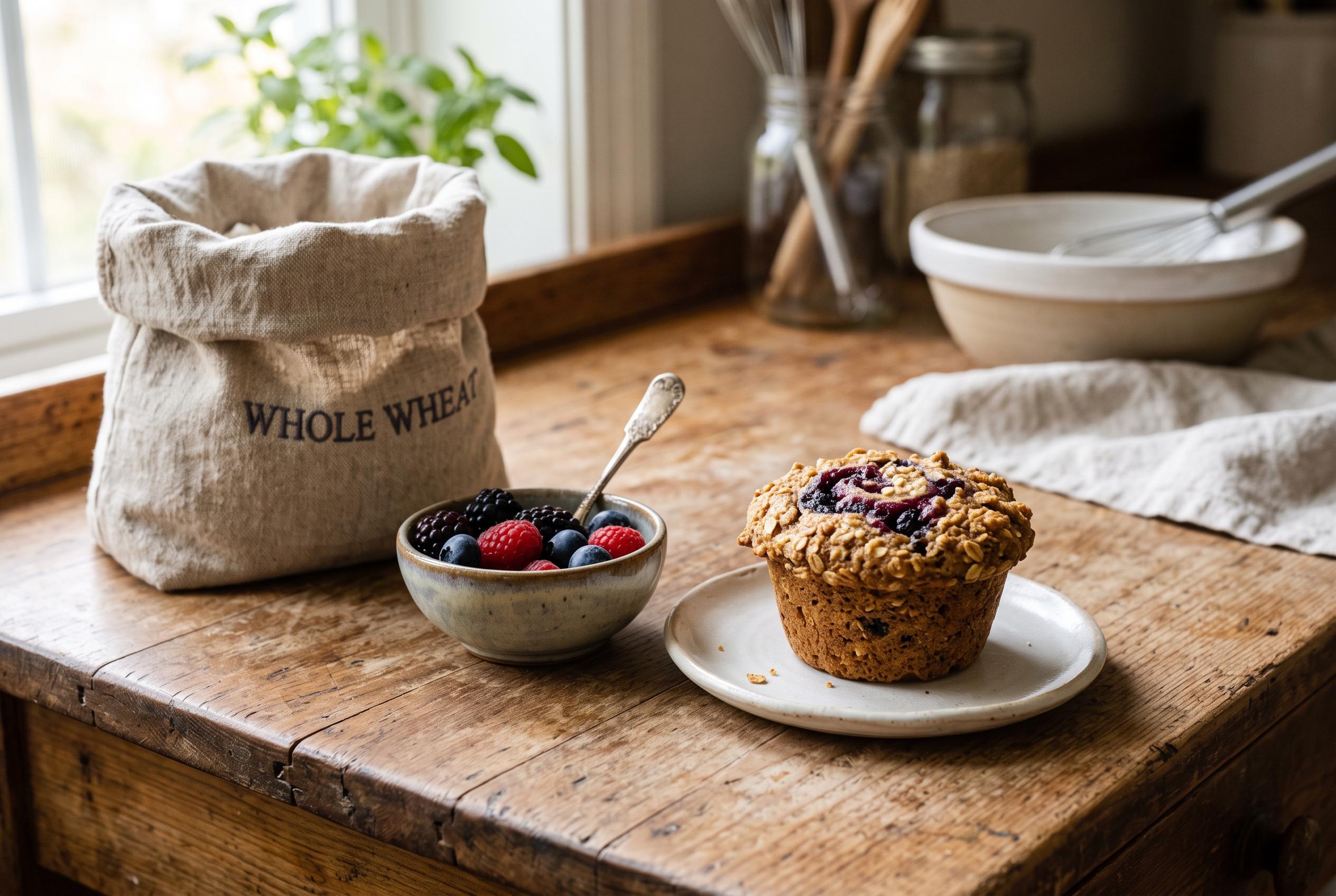

A focus on whole grains, fruit purée, and simple techniques reveals how to create nutritious muffins that appeal to families without sacrificing taste or texture, challenging the idea that healthier means less indulgent.
Making a muffin healthier is less about stripping out every indulgent ingredient than about deciding what job each ingredient has to do. Across recipes published by the NHS, BBC Good Food and The Kitchn, the versions that hold up best are not austere, sugar-free experiments; they are bakes built around whole grains, fruit purée, yoghurt or vegetables so that sweetness, moisture and texture come from more than white flour and a heavy hand with sugar.
That is clear in the NHS’s two family muffin recipes, which take very different routes. Its savoury carrot and courgette version is aimed at lunchboxes and after-school snacks, using 100g each of grated carrot and courgette with wholemeal self-raising flour and 75g of porridge oats. The result comes in at 200 calories per muffin, with 5.5g of protein and 2.7g of fibre. Its blueberry and banana muffins, by contrast, rely on mashed banana and 50g of unsweetened apple purée, yet still include 50g of soft brown or light muscovado sugar. At 227 calories each, with 14.5g of sugars, they make the useful point that a healthier muffin is not automatically a no-sugar one.
Fruit purée appears again and again because it changes more than flavour. The Kitchn’s applesauce muffins use unsweetened applesauce not just for sweetness but for tenderness and moisture, arguing that it helps bakers cut back on fat while keeping the crumb soft. BBC Good Food’s breakfast-style banana muffins take a similar approach, mixing apple sauce or puréed apple with a ripe banana, low-fat yoghurt and a modest 50ml of rapeseed oil. Cassie Best’s recipe also brings in blueberries, wholemeal flour, oats and mixed seeds, showing how a breakfast muffin can push up fibre and protein without tasting overtly virtuous.
Whole grains are the clearest common denominator. The NHS savoury muffins use wholemeal flour and oats; BBC Good Food uses 200g of wholemeal flour plus 50g of rolled oats; The Kitchn keeps the texture lighter by pairing whole-wheat flour with all-purpose flour and rolled oats. That last detail matters. Many home bakers want the nutritional advantages of a wholegrain bake but still expect a soft, springy muffin, and the mixed-flour approach explains why partial swaps often succeed where an all-or-nothing rewrite can produce something dense enough to put children off after one bite.
Technique, meanwhile, does as much work as ingredient choice. Both NHS recipes warn against over-mixing the wet and dry ingredients, and BBC Good Food gives the same advice, noting that too much stirring makes muffins heavy. All three methods keep wet and dry components separate until the last moment, then mix only briefly before baking at a standard 180C or 160C fan. In other words, a lighter muffin is usually the product of restraint, not of ever more baking powder or elaborate tricks.
For babies and toddlers, the official guidance is narrower and more practical than many social-media recipes suggest. The NHS says meal ideas such as toast or muffin fingers are suitable only once a baby is already used to eating a wide range of solid foods, and it is explicit that sugar and salt should not be added when preparing food for babies. It also recommends full-fat cheese, yoghurt and fromage frais up to the age of two. Just as important is the size and shape of the food: finger foods should be big enough for a child to hold in a fist with a little sticking out, which is a more useful rule than whether a bake carries a “baby-friendly” label.
That matters because baby-led weaning is often presented as if its benefits are settled fact. Healthline’s medically reviewed explainer says the approach begins at around six months and is based on babies feeding themselves baby-sized pieces of regular food rather than being moved gradually from spoon-fed purées. But it also says the evidence for many of the claimed advantages is mixed, with more robust research still needed. For parents, that is a sensible corrective: a soft muffin may be one way to offer familiar ingredients, but it is not a shortcut to better eating habits or guaranteed nutritional balance.
Storage is one reason muffins remain so popular with families. The NHS says its carrot and courgette muffins can be frozen for up to three months. The Kitchn gives its applesauce muffins up to five days in an airtight container at room temperature, or three months in the freezer, while BBC Good Food suggests keeping its banana muffins in a sealed container for up to three days. The practical lesson is straightforward. The most useful “healthy” muffin is the one that balances sweetness, fibre and moisture well enough to be eaten willingly, survives a lunchbox, and can be made in a batch before a busy week begins.
Disclaimer: This content is for informational purposes only and is not intended to be a substitute for professional medical judgment, advice, diagnosis, or treatment.