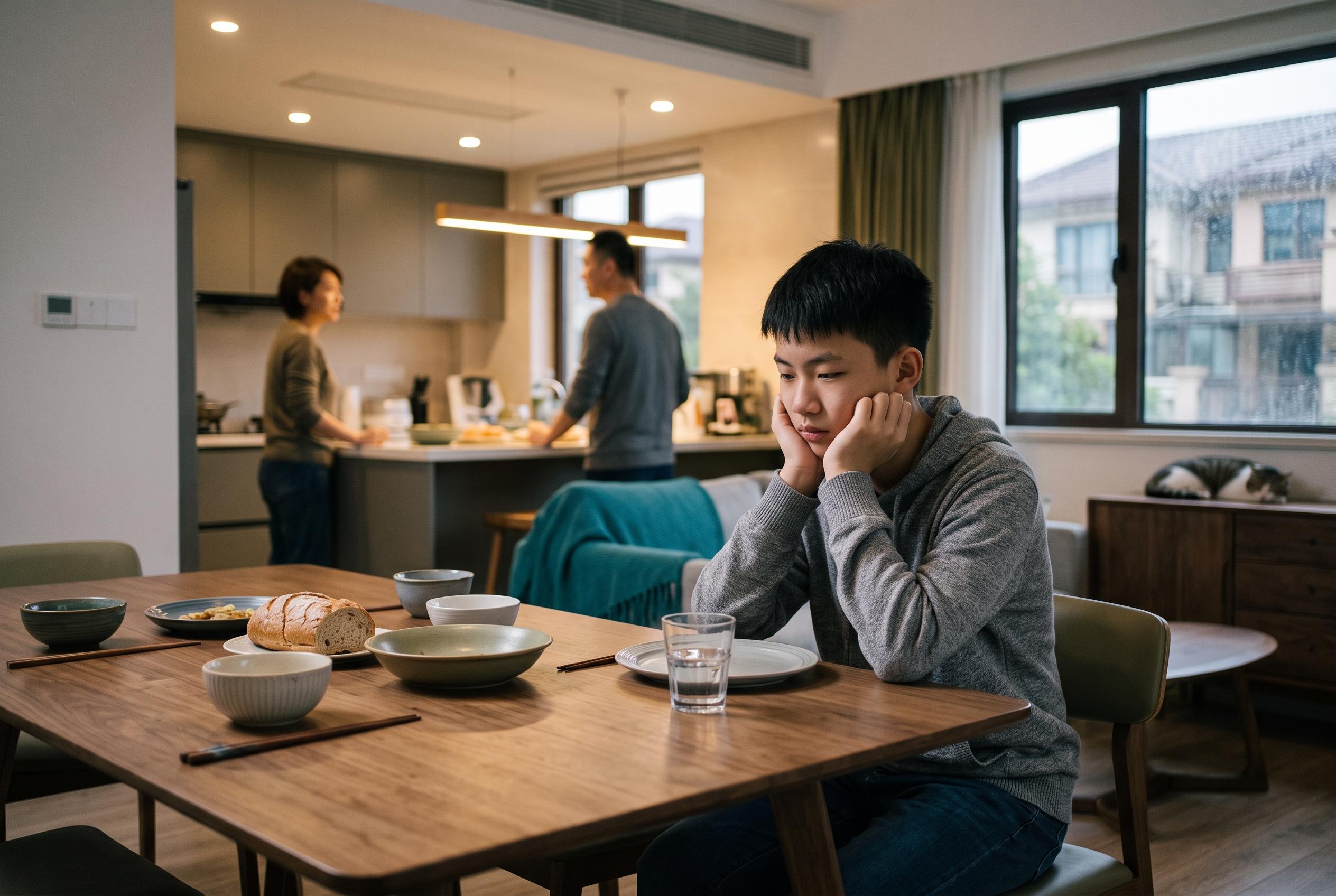

A comprehensive survey in Shandong reveals significantly increased risks of depression and anxiety among teens living in stepfamilies, especially when coupled with violent victimisation and addictive behaviours, highlighting the need for targeted mental health support.
Stepparent households emerged as the sharpest fault line in a vast new survey of teenagers in Shandong, with the heaviest mental health burden falling on adolescents who also belonged to a high-risk cluster marked by violent victimisation and addictive behaviour. In the most severe combination, pupils living in stepfather families within that cluster were 21.10 times as likely to show depressive symptoms as classmates from intact families without the same risk pattern, according to the version of record published in BMC Public Health on 5 September. Their odds of both depression and anxiety together rose to 22.70, while anxiety alone reached 9.94.
The study, led by Kaixian Wang, Mengyao Yu, Cuixia Lv and colleagues, drew on questionnaires from 292,536 students in junior, senior and vocational high schools across all 136 districts and counties of the province during 2023 and 2024. Rather than treating smoking, drinking, inactivity or poor diet as isolated habits, the researchers used latent class analysis to sort pupils by recurring behaviour patterns. They identified four groups, with an unhealthy diet pattern proving by far the most common at 40.13 per cent of the sample.
What stands out is how unevenly risk was spread across family types. The paper found that adolescents in stepmother families were most likely to fall into the violent victimisation and addictive behaviour group, with an odds ratio of 3.21, and also had the highest odds of physical inactivity at 1.89. Teenagers in stepfather families showed the strongest link with unhealthy diet patterns, at 2.40. Only single-mother households showed a modest rise in overweight risk, at 1.09. When the researchers looked directly at mental health, stepmother families carried the highest odds of anxiety symptoms, at 1.43, while stepfather families showed the highest odds of depressive symptoms, at 1.73, and of depression and anxiety occurring together, at 1.75.
Those family differences mattered, but the behaviour clusters mattered more. Adolescents in the violent victimisation and addictive behaviour class had odds ratios of 9.53 for depressive symptoms, 6.04 for anxiety and 10.18 for combined symptoms even before family structure was layered on top. That finding suggests schools and clinicians may miss the most vulnerable pupils if they screen only for household disruption or only for individual habits. The study instead points to a compounded risk profile in which exposure to violence, substance-related behaviour and family instability reinforce one another.
The paper also arrives with unusually clear publication records for research involving minors. Registry information shows it was received on 26 February, accepted on 21 August and published online on 5 September. Ethics approval came from the Medical Ethics Committee of the Shandong Provincial Centre for Disease Control and Prevention, and the authors said the work followed the Declaration of Helsinki. Parents or guardians provided written consent for participants under 16, while those minors also gave verbal assent. Crossmark records show funding from the National Natural Science Foundation of China, a Ministry of Education humanities and social science fund and a student mental health project backed by China’s National Center for Mental Health. The authors also acknowledged the limits of a cross-sectional design: the data can show association, not whether one factor caused another.
The scale of the Shandong paper did not appear from nowhere. A 2022 data paper in the Chinese Medical Sciences Journal described the province’s Database of Youth Health programme as a multi-wave survey running in the 2015/2016, 2016/2017, 2017/2018 and 2020/2021 academic years. That resource covered 99,327 students from 186 secondary schools in 17 cities and collected information on socioeconomic background, diet, mental health, school adaptation, physical activity, risk behaviour and fitness. In other words, Shandong has already become an important testing ground for research that links adolescent wellbeing to both family life and everyday conduct.
Other recent Chinese studies point in the same direction. A separate six-month panel study of 10,394 adolescents reported that young people from divorced families had higher rates of problematic internet use, depressive symptoms and anxiety than peers from non-divorced homes. The gap in problematic internet use was sizeable, rising from 21.6 per cent to 25.6 per cent across two time points in divorced families, compared with 15.3 per cent and 16.5 per cent in non-divorced families. That study also found “negative self-esteem” to be the most influential symptom in both married and divorced family groups, suggesting that the emotional consequences of family strain may be channelled through how adolescents see themselves.
A further national study of 4,003 Chinese adolescents aged 12 to 19, published this year in the American Journal of Community Psychology, found that almost half reported family or domestic violence. It concluded that smoking, alcohol use, sleep disorders and appetite loss helped mediate the damage done to health-related quality of life, while social support softened some of that harm. Gender differences were also evident. Taken together with the new Shandong findings, that wider evidence suggests the practical lesson is not simply that family change is difficult for some children, but that violence exposure, addictive or unhealthy behaviours and weak support systems can converge into a much more dangerous picture. For schools, health services and policymakers, the implication is that adolescents in stepparent homes may need earlier and more joined-up support than headline prevalence figures alone would suggest.
Disclaimer: This content is for informational purposes only and is not intended to be a substitute for professional medical judgment, advice, diagnosis, or treatment.