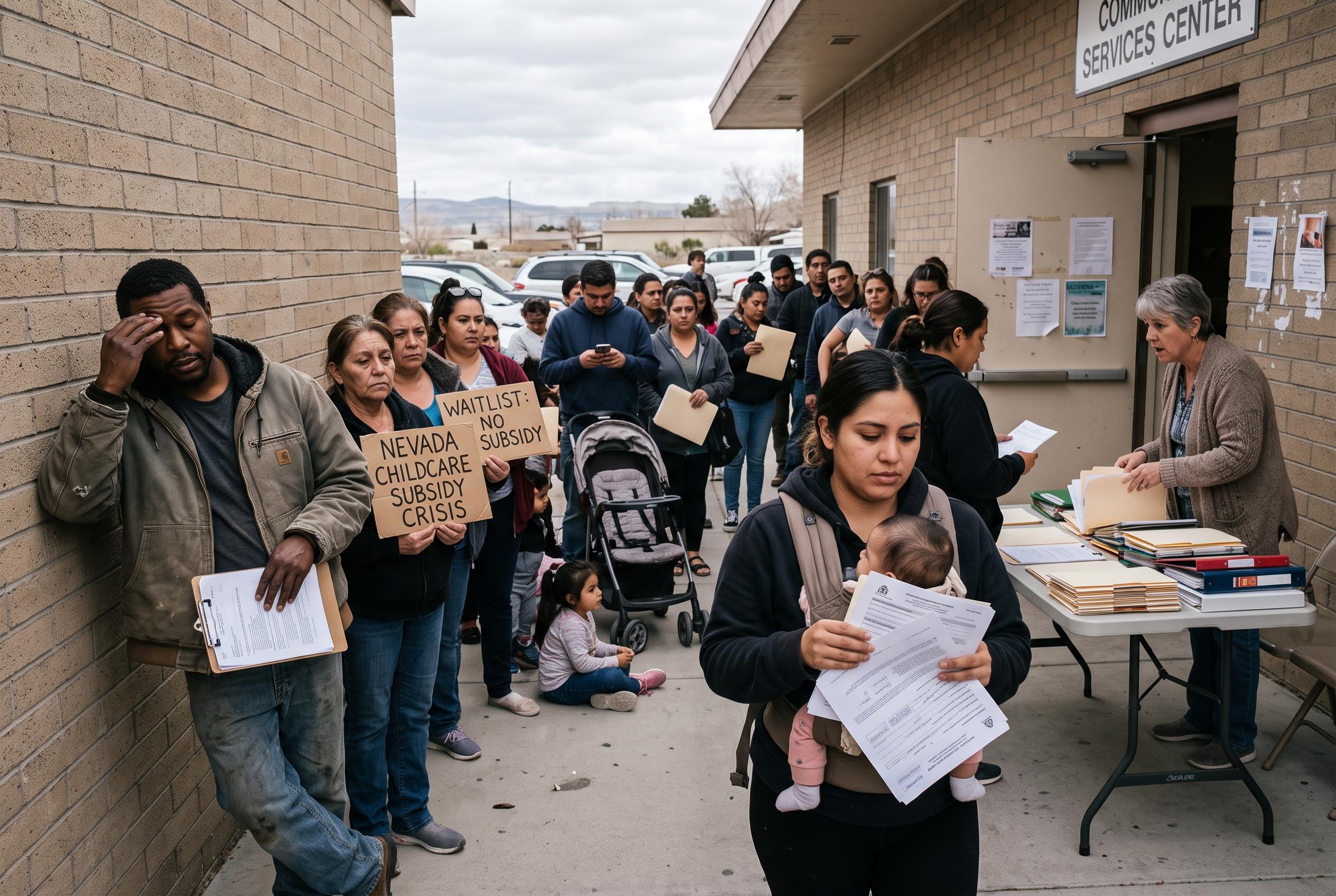

Nevada’s recent sharp reduction in childcare subsidies has exacerbated a nationwide crisis, with families facing longer waitlists and providers struggling to expand amid political resistance, as the state prepares for 2027 reform debates focused on viewing childcare as vital economic infrastructure.
Nevada childcare campaigners are using the collapse in subsidy access over the past two years as the basis for a broader 2027 reform push, arguing that the state can no longer treat long waits and vanishing eligibility as temporary problems. The Nevada Independent reported (thenevadaindependent.com) that the number of families receiving childcare subsidies fell from 15,230 in April 2024 to about 5,700 by April 2026 after Nevada tightened eligibility, while the Nevada Department of Social Services says (dss.nv.gov) that new applicants now face a waitlist with no fixed end date.
That squeeze began on 1 October 2024, when Nevada unwound the broader rules that had been sustained during the pandemic. KTNV reported at the time (ktnv.com) that income eligibility for new applicants was due to drop from as much as $76,000 a year to $39,371, with existing certificate holders and some renewals capped at $47,053. The current state rules are now set out by the Department of Social Services (dss.nv.gov), which says initial applicants must be at or below 41% of state median income, renewing families at or below 49%, and monthly family co-payments are fixed at $0, $90 or $150. Once a family reaches the front of the queue, the department says, it is guaranteed 12 months of coverage, but applications are reviewed only monthly and in chronological order.
Nevada’s retrenchment sits inside a much wider national pullback. The Associated Press reported (apnews.com) that by spring 2026 hundreds of thousands of children were on childcare-assistance waitlists in 23 states and the District of Columbia, with three more states turning away eligible families outright, after $28bn in pandemic aid expired in autumn 2024 and Congress declined to extend it. The AP’s reporting showed that some states have responded very differently from Nevada: Indiana, for example, had nearly 37,000 children waiting before Governor Mike Braun announced a $200m transfer from surplus funds, allowing roughly 8,000 children to come off the list so far. Ruth Friedman, who led the Office of Child Care under Joe Biden, told the AP that “The system is fundamentally broken.” (apnews.com)
In Nevada, the subsidy rollback has landed in a market that was already unaffordable for many families and difficult for providers to expand into. KNPR reported (knpr.org) that full-time, centre-based childcare in the state typically costs from $880 to well over $1,000 a month, and that 66% of working families with young children in Nevada cannot reasonably get the care they want or need, the highest share in the country. Elisa Cafferata of the Children’s Advocacy Alliance told KNPR that “there just aren’t the slots available in the state of Nevada” and that the state would need to triple capacity to meet demand. The same programme also quoted Chelsie Shurtleff, who runs the UNLV/CSUN preschool, saying margins are “razor-thin”, and home-based provider Jessica Gomez, who pointed to wages, learning materials and basic supplies as persistent cost pressures. (knpr.org)
That shortage helps explain why provider rules are now part of the political fight as well as subsidy funding. The Nevada Independent reported (thenevadaindependent.com) that advocates want it to become easier for relatives, neighbours and other informal carers to obtain licences and operate legally. One attempt to widen supply already failed. Nevada’s official veto archive shows (gov.nv.gov) that Assembly Bill 185 was among the measures returned by Governor Joe Lombardo on 5 June 2025. The bill, as described by The Nevada Independent, would have allowed some childcare providers to be licensed in communities governed by homeowners’ associations. Its demise has become a shorthand for how even modest expansion plans can run into organised resistance. (thenevadaindependent.com)
The Children’s Cabinet is now trying to recast the debate away from emergency help for a narrow group of parents and towards a workforce-and-economy argument. On its reports page, the organisation says (childrenscabinet.org) early care and education is part of Nevada’s economic infrastructure because it prepares children for school, enables parents to work or retrain and generates jobs and revenue in its own right. The same page points to a “State of Child Care in Nevada” demographic report and city toolkits, including one produced with Reno, to help prospective providers navigate local rules for starting or expanding a childcare business. That framing matches the agenda outlined to The Nevada Independent by Marty Elquist of the Children’s Cabinet: a more centralised early-childhood system and a higher subsidy ceiling that would eventually let families earning up to 85% of state median income qualify for help. (childrenscabinet.org)
For parents, the system already looks fragmented before any further reform is attempted. The Department of Social Services says (dss.nv.gov) families can apply through Access Nevada, with southern Nevada applicants also able to email the state directly and northern Nevada families able to send applications to the Children’s Cabinet. It directs case questions to a state email address and phone line, and sends families needing help to find an available provider to a Children’s Cabinet support address. That patchwork may be administratively workable, but it underscores the complaint made by advocates that Nevada has built a childcare structure in which affordability, supply and navigation problems reinforce one another. With lawmakers already floating childcare-related draft requests for 2027, the next battle is likely to be over whether the state treats care as a limited welfare benefit or as essential economic infrastructure. (leg.state.nv.us)
Disclaimer: This content is for informational purposes only and is not intended to be a substitute for professional medical judgment, advice, diagnosis, or treatment.