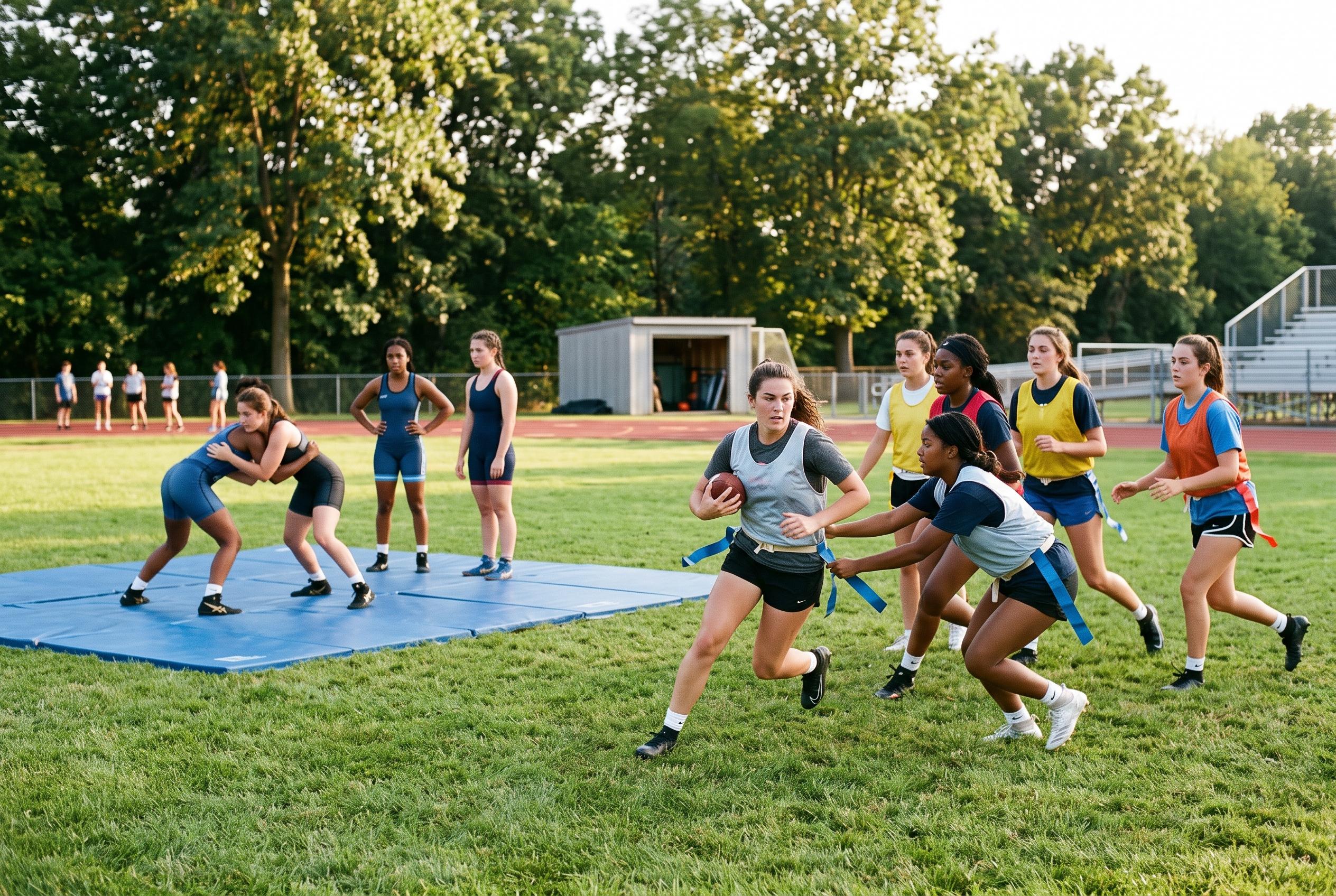

High school sports participation in the US reached a new peak in 2025-26, with a significant boost driven by girls in flag football and wrestling, signalling a shifting landscape in youth athletics.
High school sport in the United States set another participation record in the 2025-26 school year, and most of the new growth came from girls rather than boys. The National Federation of State High School Associations said 8,415,684 participants were reported by its 51 member associations, including the District of Columbia, up 149,440 on the previous year. In later commentary circulated through state bodies, the federation said roughly three-quarters of that annual increase came from girls’ sport. (nfhs.org)
The sharpest rise was in girls flag football. NFHS figures show participation leapt 48.7 per cent, from 68,847 to 102,360, pushing the sport into the girls’ top 10 nationally, while the number of schools offering it climbed from 2,736 to 3,990. The NFL’s Play Football site said that, as of early September, 24 states plus the District of Columbia treated girls flag as an official varsity sport, and that by next year 37 states will either sanction the game or run independent or pilot programmes. Since 2021-22, when 15,716 girls were recorded in the sport, the total has grown by more than 87,000. (nfhs.org)
Girls wrestling, the other main engine of growth, rose 19.9 per cent to 88,771 participants. According to the NFHS and a later Arkansas Activities Association reprint of its figures, the number of schools fielding girls wrestling has surged from 4,802 since the return from pandemic disruption to 8,853, while participation has climbed from 31,654 to 88,771 over the same stretch. All states now report some girls wrestling, and 40 state associations stage girls championships. (nfhs.org)
The lift was not confined to emerging sports. Girls volleyball passed 500,000 participants for the first time and, at 502,056, now sits only 7,014 behind girls outdoor track and field, the NFHS said. Girls basketball, a sport whose numbers had fallen by about 100,000 over the past two decades, added 6,142 participants to reach 362,382, while girls golf rose 6.3 per cent to 90,176. Overall, girls participation reached a record 3,654,589, compared with a record 4,761,095 for boys. (nfhs.org)
Football still dwarfs every other school sport by total numbers. The NFHS survey put boys’ 11-player football at 1,043,716, up 14,128 and at its highest level since 2016-17. Add 33,191 boys in 6-, 8- and 9-player versions and 4,334 girls across tackle formats, and total football participation reached 1,081,241. Davis Whitfield, the NFHS executive director, said: “It is great to see new sport opportunities created to involve as many students as possible in high school sports.” (playfootball.nfl.com)
The gains, however, were uneven. National Amateur Sports, citing the same survey, noted falls in softball, down 7,153 participants, baseball, down 5,068, and boys wrestling, down 4,955, while boys basketball, girls soccer and girls outdoor track also declined. The group’s argument was that schools now have to fund expansion in fast-growing sports without allowing longer-established ones to wither, covering everything from kit and coaches to transport, officials and access to facilities. (nasathletics.com)
The state-by-state picture shows how widely spread the growth has become. NFHS figures place Texas first with 911,405 participants and California second with 859,022, followed by Ohio, Illinois and Pennsylvania. Coach and Athletic Director noted that Ohio had already sanctioned girls flag football in June 2026, a local sign of the national shift, while the same participation story was quickly republished by state-facing outlets including Arizona’s AZPreps365 and the Arkansas Activities Association. (nfhs.org)
That matters to school leaders because the survey is treated as the most comprehensive national view of education-based sport. The NFHS says it has compiled the study since 1971 through every state association and the District of Columbia, and Whitfield wrote this week that participation has risen by nearly 800,000 since school sport returned after the pandemic. He argued that students still value these programmes because they do more than satisfy a wish to compete and can, in his words, “meet relationship and mental health needs as well”. (nfhs.org)
Disclaimer: This content is for informational purposes only and is not intended to be a substitute for professional medical judgment, advice, diagnosis, or treatment.