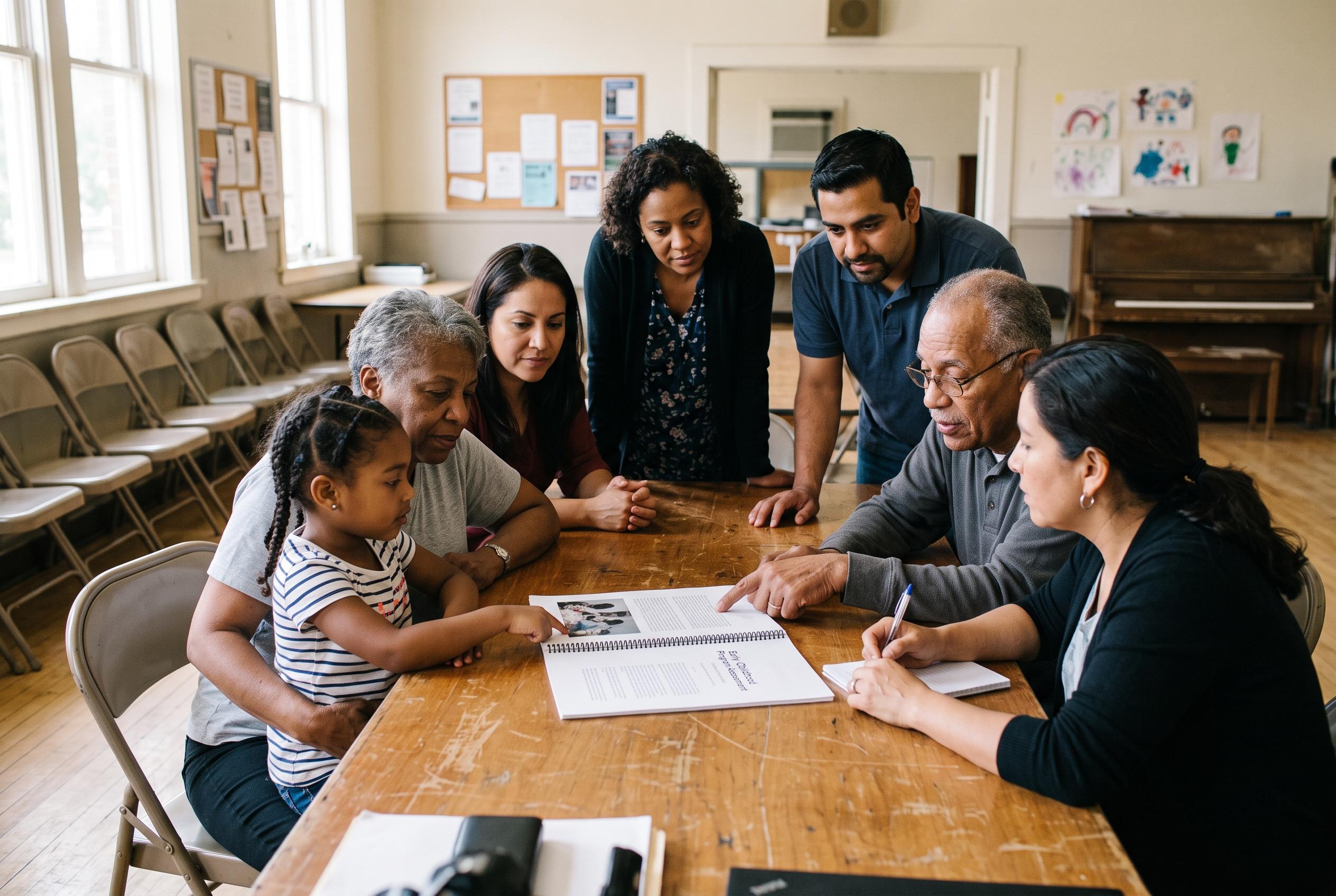

Florencia Clara Lopez Boo of NYU receives the Khalifa International Award for her pioneering research demonstrating how community monitoring can ensure high-quality, scalable early childhood services in low- and middle-income countries, highlighting the importance of community involvement in effective programme expansion.
Research showing that community oversight can improve the quality of home-visiting services for very young children at scale, according to an Inter-American Development Bank working paper and a later journal article in The World Bank Economic Review, (publications.iadb.org) has helped carry New York University economist Florencia Clara Lopez Boo to the Khalifa International Award for Early Learning. The award’s official winners list identifies her as Prof. Florencia Clara Lopez Boo of New York University, honoured in the Research and Studies field for work on improving quality in early childhood development interventions across low- and middle-income countries. (khaward.ae)
The recognition was conferred as part of the nineteenth Khalifa Award for Education ceremony in Abu Dhabi on 13 May 2026, when Sheikh Nahyan bin Mubarak Al Nahyan honoured 40 winners across UAE, Arab and international categories, according to the award organisers. (khaward.ae) Organisers said the edition drew nominees from 52 countries and included four winners in the international early-learning strand from the United States and the United Kingdom. (khaward.ae) The event was attended by senior UAE education figures including Sarah Al Amiri, the minister of education, as well as Mugheer Khamis Al Khaili of Erth Zayed Philanthropies and Hajer Ahmed Al Thehli of the Education, Human Development and Community Development Council. (khaward.ae)
What sets Lopez Boo’s work apart is not simply that it argues for more spending on early childhood services, but that it examines what happens when governments try to expand them without losing quality. In the Nicaragua study cited by the Inter-American Development Bank, (publications.iadb.org) researchers evaluated a government home-visit parenting programme that reached 32,900 children, roughly 90% of zero- to three-year-olds in rural municipalities. The journal abstract says the programme raised child development scores by 0.11 standard deviations and increased the likelihood of preschool completion by seven percentage points, while local-average effects for children who actually received visits were larger still. (academic.oup.com)
The mechanics of that result matter. The IDB paper says the programme offered 60-minute visits every fortnight at a cost of $100 per child per year, and that researchers tracked observations collected between 2013 and 2017. (publications.iadb.org) Those records included 2,130 observations in communities assigned standard home visits and 2,783 in communities where home visits were paired with community monitoring. (publications.iadb.org) The paper found that community-monitored visits were 0.12 standard deviations higher in overall quality, equivalent to roughly two more checklist items being delivered well, and concluded that the work was “among the first to provide experimental evidence of a government-run home visit program implemented at scale in a high poverty country”. (publications.iadb.org) The later Oxford Academic version said the evidence helps answer a central scale-up question: “how to ensure quality”. (academic.oup.com)
Lopez Boo’s wider record helps explain why that argument resonated. NYU Steinhardt describes her as director of Global TIES and professor of economics and applied psychology, with a doctorate in economics from the University of Oxford and earlier degrees from the University of Namur and the University of Buenos Aires. (steinhardt.nyu.edu) The university says her research centres on rigorous evaluations of human-development programmes implemented nationally in low- and middle-income countries, especially in Latin America and the Caribbean, and that before joining NYU she was lead economist in the Social Protection and Health Unit at the Inter-American Development Bank, where she led its early childhood development team. (steinhardt.nyu.edu) Her profile also lists advisory or research work with governments ranging from Argentina and Brazil to Jamaica, Nicaragua, Panama and Peru. (steinhardt.nyu.edu)
The award package around her victory also shows how the organisers want the research to circulate. On the award’s Winners Publications page, (el.khaward.ae) Lopez Boo’s entry appears in the “Best Research and Studies” section with a file link to the work itself. The same archive places her alongside another research winner, Shonchoy’s paper on scaling early childhood development through public infrastructure, and alongside practice-focused winners such as the Brief Early Childhood Quality Inventory Together in Practice system. (el.khaward.ae) The official May ceremony report separately named early-learning winners from ECD Measure and Sabre Education in the programme and teaching-practice category. (khaward.ae)
There are, however, small inconsistencies across the organisers’ English-language material. The official winners PDF records Lopez Boo’s project as “Research Study to Inform Quality Improvement at Scale in Early Childhood Development Interventions in Low and Middle-Income Countries”, (khaward.ae) while the ceremony report rendered it as “Research Study to Guide Large-Scale Quality Improvement in Early Childhood Development Interventions in Low- and Middle-Income Countries”. (khaward.ae) The same split appears in the listing for the other research honouree: the winners PDF uses “Abu Syeid Mohammed Parves Shonchoy” and “Doing More with What Exists”, (khaward.ae) whereas the ceremony report says “Abu Said Mohammad Parvez Shonchoy” and “Making the Most of What Exists”. (khaward.ae)
Even with those variations, the broader message is clear. Since its launch in 2007, the Khalifa Award for Education has tried to position Abu Dhabi as a meeting point for educational practice and applied evidence, the organisers say, (khaward.ae) and Lopez Boo’s award fits that ambition neatly. Her research suggests that early-childhood systems in poorer settings do not fail only because money is scarce; they can also fall short when expansion outruns implementation quality. For governments trying to reach children early and at scale, the lesson from Nicaragua is that monitoring is not an administrative afterthought, but part of the intervention itself. According to the journal abstract, (academic.oup.com) the gains were strongest where quality was actively reinforced by the community as well as the state.
Disclaimer: This content is for informational purposes only and is not intended to be a substitute for professional medical judgment, advice, diagnosis, or treatment.