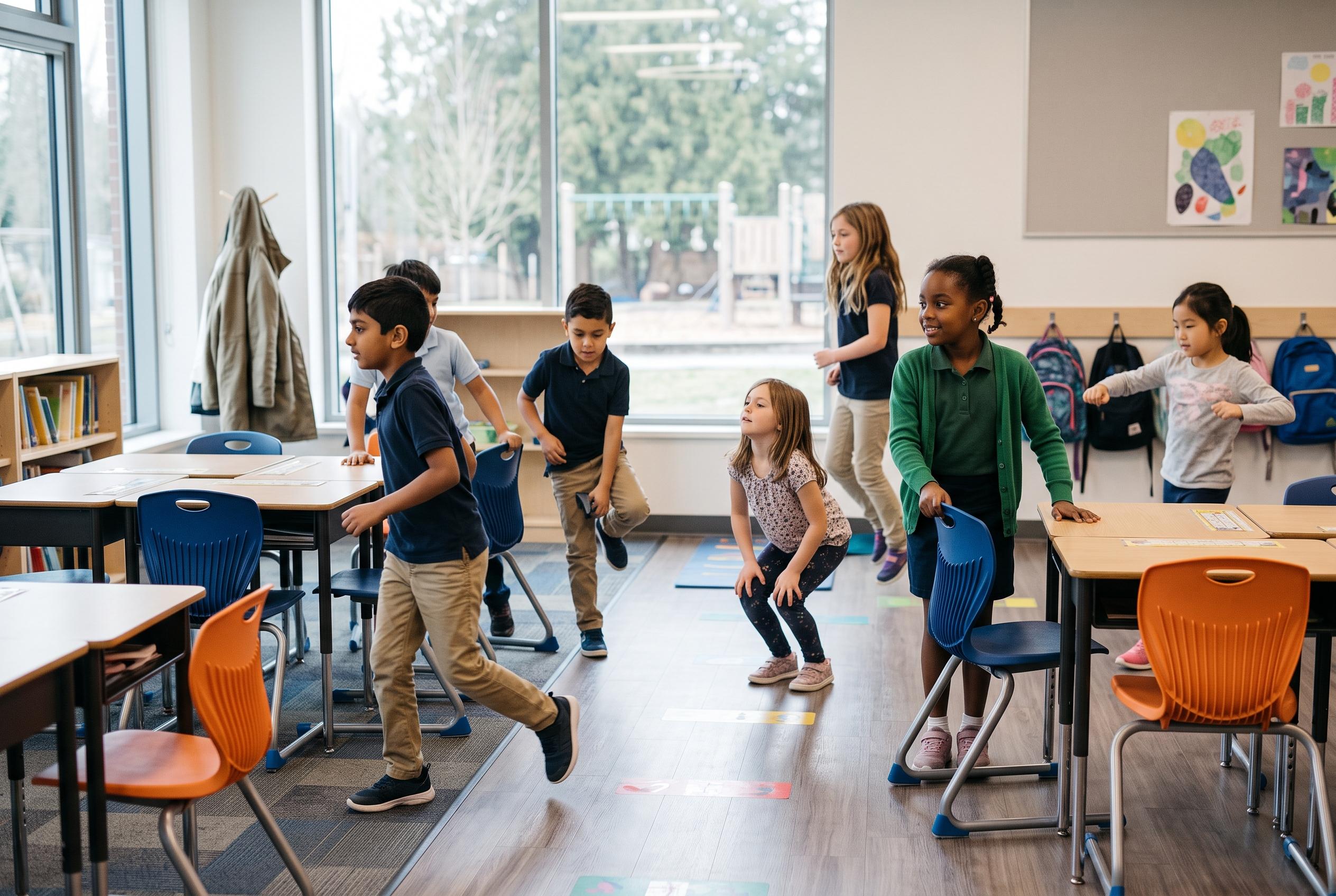

Experts and health authorities emphasise the importance of integrating regular movement into children’s school days, highlighting how simple routine changes can prevent posture issues, boost attention, and promote lifelong healthy habits amid the shift to more sedentary indoor activities at the start of the term.
The sharpest change for many children at the start of term is not the timetable itself, but the amount of sitting it imposes. Safa Heybet, a physiotherapy and rehabilitation specialist at Biruni University, has warned that lessons, school transport, homework and extra screen time can turn a child who was active through the summer into one who spends most of the day still. That concern sits squarely within wider public-health advice: the World Health Organization says people aged five to 17 should get at least 60 minutes of moderate to vigorous physical activity a day, and makes clear that ordinary movement such as walking or cycling counts alongside organised exercise.
Doctors say the consequences are not limited to fitness. Adnan Karaoğlu, an orthopaedics and traumatology specialist at Medicana Bahçelievler Hospital, told DHA that the move from outdoor play to prolonged desk time can show up as neck, shoulder, back and lower-back pain, muscle fatigue and posture complaints, particularly because children’s muscles, joints and spines are still developing. He said parents should watch for repeated or worsening back pain, pain triggered by movement, reluctance to take part in sport and any sign that discomfort is beginning to interfere with daily life.
Karaoğlu also drew a distinction that often gets lost in school-start discussions. A heavy bag or poor sitting position does not, he said, directly cause scoliosis, but it can aggravate discomfort or make an existing posture problem more obvious. He urged families to pay attention if one shoulder looks higher than the other, one shoulder blade appears more prominent or the torso seems to lean to one side. Just telling a child to sit up straight is unlikely to solve much on its own, he added, if the desk and chair do not fit the child’s height, their feet do not rest properly on the floor, or they are expected to hold the same position for hours.
That is why the debate is shifting from after-school sport to what happens inside the school day itself. On its recess guidance, the US Centers for Disease Control and Prevention describes break time as a regular part of the day that can raise physical activity, improve memory, attention and concentration, help pupils stay on task and reduce disruptive classroom behaviour. The agency’s materials treat recess as a structural health measure rather than a reward or a pause in learning. In one Oklahoma initiative highlighted by the CDC, colourful painted play spaces were introduced across four local education agencies and one pilot school, reaching 2,469 pupils.
The research base behind short movement breaks is more cautious than some enthusiastic claims suggest, but it is broadly supportive. A systematic review and meta-analysis published in 2021 found that active breaks in class are usually brief, often lasting five to 15 minutes. The authors reported some positive immediate and longer-term effects on measures including concentration, inhibition, sustained attention and, in particular, selective attention. At the same time, they noted that many findings were not statistically significant and that study designs varied widely. Their central conclusion was restrained: these breaks do not clearly transform cognition in every setting, but they also do not “compromise students’ attention”.
Practical guidance from the CDC follows the same logic. Its classroom activity advice says movement can be built into lessons or added in several short bursts through the day, and should come in addition to physical education and recess rather than replace either. The agency says such activity can lift overall movement levels and may improve attention, classroom behaviour and test scores. It also frames the issue as one for school organisation, not just family discipline, suggesting parents ask whether schools have policies on daily classroom activity, whether teachers receive training, and whether adjustments are available for children with health conditions or disabilities.
Turkey’s Health Ministry has made a similar argument from a different angle. In guidance issued during the mid-year break on 16 January 2026, when about 18 million pupils were leaving school for the holiday, the ministry said school-age years are a period when both learning and lifelong habits are formed. It warned that letting routines drift too far during breaks can make it harder for children to settle back into term, and urged families to protect sleep and meal patterns, curb recreational screen time and keep children moving. The ministry also said physical activity can improve mood, reduce stress and make it easier to sleep.
Taken together, the message from clinicians, researchers and health agencies is less about adding one more club to a child’s diary than about redesigning ordinary routines. A football session in the evening does not cancel out a day spent almost entirely seated. What matters is whether movement is threaded through the hours between home and classroom: safe routes for walking or cycling, playgrounds that invite active play, desks and chairs that fit properly, and lessons that allow pupils to stand, stretch or reset before attention fades. For schools and parents alike, the most useful test may be simple: not whether a child does sport sometimes, but whether the day gives them enough chances to move at all.
Disclaimer: This content is for informational purposes only and is not intended to be a substitute for professional medical judgment, advice, diagnosis, or treatment.